
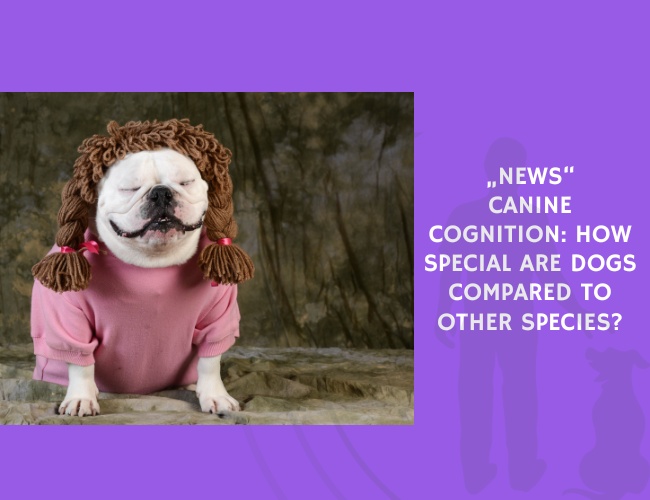
Canine cognition has long fascinated researchers, partly because dogs appear uniquely attuned to humans—capable of reading gestures, interpreting emotions, and forming cooperative social bonds across species lines. However, this 2018 special issue from Learning & Behavior challenges the common belief that dogs possess uniquely superior cognitive abilities.
According to Katz and Huber, dog cognition is indeed shaped by three major influences:
- Evolutionary and domestication forces — Human selection for sociability, attention to human cues, and cooperative temperament.
- Ecological adaptation — Dogs’ transition from wolf-like group hunting to solitary scavenging lifestyles changed social strategies and reliance on humans.
- Individual learning and experience — Human environments continually refine dogs’ problem-solving and communication skills.
However, when comparing dogs to cognitively advanced species like wolves, spotted hyenas, cats, dolphins, horses, and chimpanzees, the study concludes:
Dogs show strong social and cognitive abilities—but do not stand out as uniquely exceptional across species.
This critical insight reframes canine cognition not as “superior,” but as species-specialized. Dogs excel in human-interaction cognition, but wolves outperform them in physical problem-solving, and other species exceed them in memory, planning, or spatial reasoning. The dog’s real adaptation is not generalized intelligence, but relational cognition: a biological readiness for cross-species synchronization.
This aligns strongly with the Invisible Leash and NeuroBond framework: dogs are not the smartest problem solvers—but they are uniquely sensitive to emotional alignment, social attunement, and cooperative learning with humans. Their intelligence is contextual, relational, and emotionally embedded—making them partners, not performers.
Key Takeaways for Dog Behavior and Training:
- Canine intelligence is situational—not absolute.
- Dogs are cognitively optimized for human-dog collaboration, not abstract reasoning.
- Free-roaming village dogs demonstrate ecological intelligence beyond typical pet-dog behavior.
- Training methods must shift from obedience to cognitive partnership and emotional clarity.
Ultimately, dogs’ cognitive strength lies not in being superior, but in being uniquely synchronized—with humans. Their intelligence is relational, not solitary.
Source: Katz, J., & Huber, L. (2018). Canine cognition. Learning & Behavior.









