
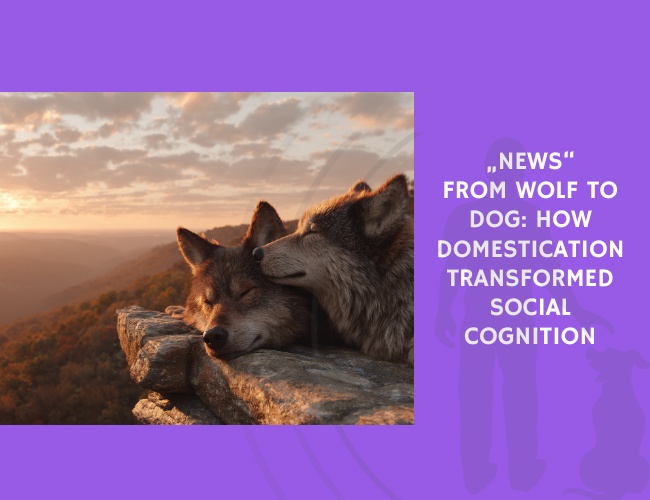
Published in 2006, this foundational study by Kubinyi, Virányi, and Miklósi explores how the process of domestication fundamentally reshaped the dog’s social cognition—particularly its capacity for social attraction, behavioral synchrony, and human-directed communication. By comparing dogs and wolves raised under identical hand-rearing conditions, the researchers were able to isolate species-specific cognitive changes rather than environmental effects.
Key discovery: Even when raised like wolves, dogs uniquely develop human-oriented social cognition. That means their tendency to seek, sync, and communicate with humans is not learned—it is genetically embedded through domestication.
While wolves can form social bonds with caregivers, they do not naturally engage in the same kind of affiliative synchrony, voluntary gaze communication, gesture-reading, or cooperative problem-solving that dogs consistently exhibit. Dogs showed:
- Social attraction: A spontaneous tendency to seek emotional proximity to humans rather than just functional association.
- Behavioral synchrony: Dogs naturally aligned their movements, attention, and reactions with humans—an early sign of emotional and cognitive attunement.
- Communicative sensitivity: Dogs used and understood human cues (gaze, pointing, body posture) with remarkable accuracy, unlike wolves raised identically.
These findings helped shape a central concept in modern canine cognition: “Domestication did not merely tame dogs—it selected for interspecies social cognition.”
This shift represents an evolutionary leap: dogs developed a socio-cognitive bridge to humans, creating a unique bi-species attachment system. Such mechanisms—behavioral synchrony, referential communication, emotional contagion—are also foundational to human socio-cognitive evolution, suggesting dogs may serve as a mirror for understanding early human bonding, cooperation, and communication.
In the NeuroBond and Invisible Leash frameworks, this evolutionary insight confirms that dogs are biologically prepared for connection-based learning, rather than dominance-based conditioning. Their true learning channel is not obedience, but social alignment.
Training implication: The dog does not simply respond to commands—it responds to connection. Behavioral stability comes not from control, but from attunement, synchrony, and relational clarity—the exact mechanisms that domestication amplified.
Source: Kubinyi, E., Virányi, Z., & Miklósi, Á. (2006). Comparative social cognition: From wolf and dog to humans. Biology & Psychology.










