

Introduction: The Familiar Tug Towards Home
Have you ever noticed how your relaxed companion on the outward walk suddenly transforms into a determined puller the moment you turn homeward? You are not alone. Many dog owners observe this distinct shift in leash manners as their dogs approach home, and it tells a fascinating story about canine cognition, emotion, and physiology.
This homeward urgency is not stubbornness or disobedience. It is a complex interplay of your dog’s remarkable spatial abilities, powerful anticipatory systems, and learned associations that have been quietly reinforced over countless walks. Understanding why your dog pulls harder when heading home opens the door to more effective training strategies and a deeper appreciation of what is happening in your companion’s mind and body during those final blocks of your journey together.
Let us explore the science behind this common behavior and discover how you can transform those stressful homeward stretches into calm, connected moments. 🧡
Spatial Cognition & Route Anticipation: Your Dog’s Internal GPS
How Dogs Navigate Their World
Your dog possesses remarkable spatial abilities that go far beyond simple memory. Their understanding of “home” is not merely knowing which direction to turn at the corner. It is a deeply encoded mental map woven with sensory memories, emotional significance, and reward associations that create a powerful navigational compass.
The multi-sensory home detection system
Dogs recognize the “home direction” through an intricate combination of sensory inputs:
- Olfactory navigation: Their highly developed sense of smell detects subtle scent trails left on the outward journey, growing stronger and more familiar as they approach home
- Visual landmarks: Trees, buildings, street corners, and familiar objects create a mental map of recognizable waypoints along the route
- Auditory cues: The subtle shift in sounds as familiar neighborhood noises grow louder, from the hum of their home’s air conditioning to the barking of a neighbor’s dog
- Proprioceptive memory: An internal sense of the turns taken, distances traveled, and physical movements that created the original path
- Magnetic field detection: Some research suggests dogs may have limited magnetoreception that aids in directional awareness
Research into hippocampal spatial mapping reveals that dogs encode return routes more efficiently than outward journeys due to familiarity and strong reward associations. Think of it this way: your dog’s brain has created a detailed map where “home” glows like a beacon, illuminated by every positive experience associated with that destination.
When cognitive maps meet anticipation
As your dog nears home, this cognitive map becomes imbued with emotional weight. The neutral information of “turn left here, then three blocks straight” transforms into “turn left here towards comfort, then three blocks to dinner and rest.” This shift triggers anticipatory arousal that manifests as increased locomotor drive. Your dog is not just walking anymore—they are being pulled forward by an internal urgency that makes maintaining a loose leash increasingly difficult.
The Activation of the SEEKING System
At the neurological level, something profound happens as your dog recognizes the homeward route. The brain’s SEEKING system, a fundamental neural circuit associated with appetitive behaviors and the pursuit of rewards, becomes highly engaged. This system, primarily driven by dopamine, generates a state of eager anticipation that promotes locomotor activity aimed at acquiring desired outcomes.
When your dog anticipates the rewards waiting at home—food, water, rest, and your presence—the SEEKING system floods the brain with motivational energy. This is not mere excitement. It is a deep, evolutionarily conserved drive system that compels movement toward resources necessary for survival and wellbeing. Through the NeuroBond approach, we understand that this neurological activation creates a state where awareness and self-regulation become challenging, making calm communication between you and your dog temporarily disrupted.
Home as a Learned Reward
Dogs are masters of associative learning. Through repeated experiences, they form powerful connections between the act of returning home and the subsequent delivery of various rewards. Consider what awaits your dog at the end of each walk:
Primary reinforcers
- Fresh water quenching their thirst
- Meals or treats satisfying hunger
- A comfortable resting place relieving tired muscles
- Relief from environmental stressors like heat, cold, rain, or overwhelming stimuli
- The opportunity to relieve themselves in familiar territory
Secondary reinforcers
- Reunion with family members
- Access to favorite toys
- The cessation of the walk itself, which for some dogs represents relief from overstimulation
- Return to predictable routines and safe spaces
Each successful return home, followed by these positive outcomes, strengthens the neural pathway connecting “homeward walking” with “reward acquisition.” This robust conditioning creates what we call a highly salient destination—a place that demands your dog’s attention and motivates their behavior with increasing intensity as proximity increases.
Did you know that this learned association can become so powerful that some dogs begin showing anticipatory behaviors blocks before home, reading cues you may not even realize you are giving? 🧠
Arousal & Autonomic Activation: The Physiology of Urgency
The Sympathetic Response
The anticipation of returning home involves significant physiological changes, particularly within the autonomic nervous system. When your dog recognizes the homeward route, the sympathetic nervous system—the “action branch” that prepares the body for activity—becomes increasingly activated.
What happens in your dog’s body
You might notice several physical changes as your dog’s urgency builds:
- Cardiovascular acceleration: Heart rate increases to deliver more oxygen to muscles primed for movement
- Muscular tension: Body-wide muscle engagement creates a tauter posture and generates stronger pulling force on the leash
- Respiratory changes: Breathing becomes faster and often shallower, with visible panting even in cool weather
- Pupillary dilation: Eyes widen to enhance visual intake of the approaching destination
- Postural shifts: The body leans forward, weight transfers to the front legs, and the neck extends
- Decreased responsiveness: Ability to process and respond to verbal cues diminishes as arousal increases
These are not conscious choices your dog makes; they are automatic physiological responses to anticipated reward.
This sympathetic activation explains why your dog’s pull feels qualitatively different on the homeward journey compared to the outward walk. The increased muscle tension and cardiovascular readiness create genuine physical capacity for stronger pulling, while simultaneously making it harder for your dog to maintain the impulse control necessary for loose-leash walking.
The Dopamine Surge
At the neurochemical level, a measurable rise in dopamine accompanies this homeward approach. Dopamine’s role in reward prediction and motivation means that dopamine neurons fire intensely not when the reward is received, but when the predicted reward is imminent.
As your dog approaches home, anticipating food, water, comfort, and social connection, dopamine surges through the brain’s reward pathways, particularly the nucleus accumbens. This neurochemical cascade creates a powerful motivational drive that accelerates locomotion and reduces impulse control. The brain is essentially broadcasting a powerful signal: “Go get the reward now!”
This dopamine-driven state helps explain why training techniques that work beautifully on the outward walk sometimes seem ineffective on the return journey. Your dog is operating under the influence of a neurochemical system specifically designed to override inhibition and promote reward-seeking behavior. The Invisible Leash—that subtle energetic connection built on mutual awareness—becomes harder to maintain when your dog’s internal chemistry is screaming “home.”
Homeward Urgency vs. Outward Exploration
Understanding the difference between these two arousal states helps explain why the same walk feels like two different experiences.
Outward-walk exploratory arousal is driven by novelty, curiosity, and environmental investigation. It involves diffuse, investigative attention characterized by sniffing, scanning, and willingness to deviate from a direct path. While excitement may cause some pulling, it is generally less sustained and less goal-directed. The dopamine system responds to novel stimuli and the general pleasure of exploration.
Homeward urgency represents highly goal-directed, anticipatory arousal driven by strong expectations of specific, high-value rewards at a known destination. It manifests as focused, linear drive towards home with reduced interest in environmental distractions. The sympathetic activation is more intense and sustained, fueled by powerful dopamine surges associated with imminent reward. This urgency often overrides impulse control, leading to persistent, strong pulling that can feel almost compulsive.
Recognizing this distinction helps you understand that your dog is not being inconsistent or difficult—they are responding to two fundamentally different neurological states. 🐾

Behavioral Conditioning & Learning: How We Accidentally Teach Pulling
Inadvertent Reinforcement
Here is an uncomfortable truth for many dog owners: we often inadvertently reinforce the very pulling behavior we find frustrating. This falls under what behaviorists call conditioned urgency.
Common reinforcement patterns
When your dog pulls strongly towards home, you might respond in ways that unintentionally reward the behavior:
- Walking faster: Speeding up to keep pace with your dog or to reach home more quickly, effectively allowing them to achieve their goal while pulling
- Shortening the leash: Creating constant tension that teaches your dog pulling is the default leash state
- Reducing stops: Eliminating or minimizing pauses for sniffing or exploration to expedite the homeward journey
- Giving up on training: Abandoning loose-leash protocols on the final stretch because you’re tired or eager to get home
- Using physical corrections inconsistently: Pulling back on the leash sometimes but not others, creating confusion about expectations
- Verbal frustration without consequence: Saying “stop pulling” repeatedly while continuing to move forward, teaching your dog that words have no meaning
Each instance where pulling leads to faster access to home acts as positive reinforcement, strengthening the pulling behavior. Your dog’s brain registers: “When I pull hard, we get home faster, and I get my rewards sooner.” This learning is powerful precisely because it is consistently reinforced on every walk.
The Self-Perpetuating Cycle
This creates a challenging cycle. The more your dog pulls and reaches home, the stronger the behavior becomes. The stronger the behavior, the more difficult it is to maintain patience and training protocols on the homeward stretch. The more you allow pulling to work, the more deeply ingrained the pattern becomes.
Breaking this cycle requires understanding that you are not just training new behaviors—you are working against a well-established learned pattern that has been reinforced potentially hundreds of times. This is why consistency becomes absolutely critical in addressing homeward pulling.
Breed-Specific Considerations
Some breed characteristics amplify the homeward pulling tendency:
- Sled and pulling breeds (Huskies, Malamutes, Samoyeds): Genetically selected for sustained pulling effort and stamina, making leash tension feel natural and comfortable
- Herding breeds (Border Collies, Australian Shepherds, Corgis): High drive and goal-oriented focus can create intense determination when moving toward a perceived objective
- Sporting breeds (Labradors, Golden Retrievers, Spaniels): Strong food motivation amplifies anticipatory arousal when home and dinner are near
- Terriers (Jack Russells, Bull Terriers): Independent nature and high energy can manifest as determined pulling when they’ve decided on a direction
- Working breeds (Rottweilers, Dobermans, German Shepherds): Powerful builds combined with protective instincts may create strong homeward pull, especially if they view home as territory to patrol
- Scent hounds (Beagles, Bloodhounds, Bassets): While often distracted outward, can show remarkable single-mindedness when they’ve identified the home scent trail
This does not mean these breeds cannot learn loose-leash walking on the homeward journey, but it does mean the challenge may be greater and require more consistent training effort.
Understanding your dog’s breed tendencies helps you approach training with realistic expectations and appropriate patience. 🧡
Homeward. Driven. Inevitable.
Familiar routes ignite urgency.
As your dog recognises the sensory markers leading back to their safe space, anticipation heightens and the body shifts into a forward-focused drive that outpaces normal leash manners.
Cognitive maps fuel momentum.
Their internal GPS lights up with scent trails, landmarks, and proprioceptive memory, turning the return path into a rewarding, emotionally charged destination.
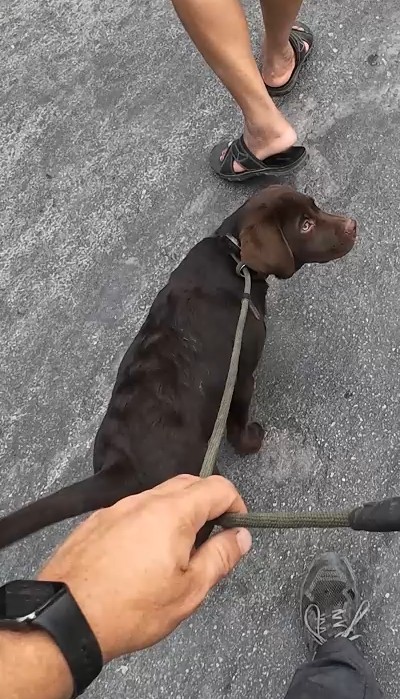
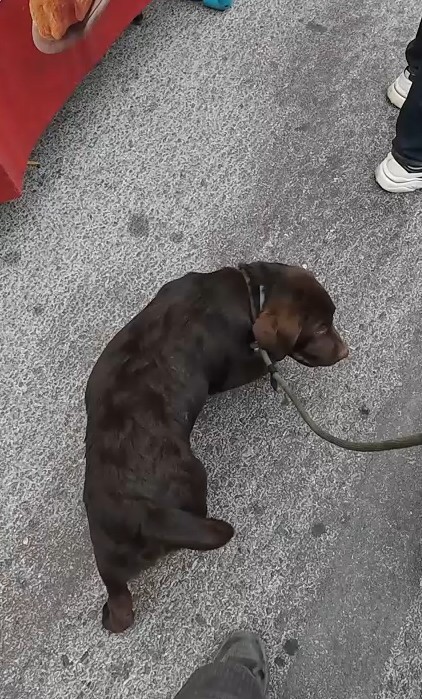
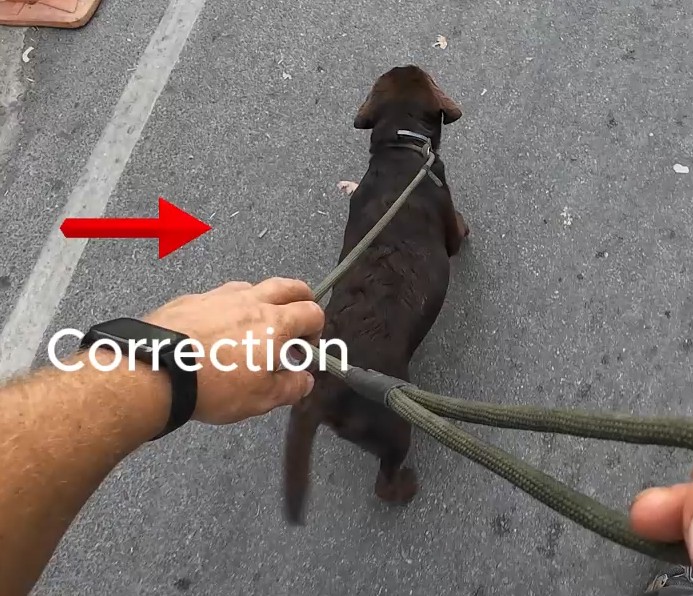
Anticipation amplifies arousal.
The promise of rest, routine, and comfort activates powerful reward circuits that increase speed and determination.
Contextual & Motivational Amplifiers: What Makes It Worse
Time of Day and Physiological State
The intensity of homeward pulling often varies depending on when the walk occurs and your dog’s current physical state. These contextual factors amplify the baseline motivational pull of home.
Hunger before meals
If your walk coincides with your dog’s usual mealtime, the anticipation of food will be extraordinarily high. The combination of genuine hunger plus the learned association of “home equals food” creates a powerful dual motivation. The dopamine surge in this state becomes even more intense, making impulse control particularly challenging.
Environmental discomfort
Dogs experiencing discomfort from extreme weather find home’s appeal significantly amplified. Hot pavement burning paws, cold wind chilling the body, or rain soaking the coat all increase the motivation to return to comfort quickly. In these situations, home represents not just reward but relief from active discomfort, adding an urgency component that goes beyond simple reward anticipation.
Fatigue and overstimulation
After a long or particularly stimulating walk, your dog may simply be tired and desire rest. Mental and physical fatigue reduce impulse control generally, while simultaneously increasing the appeal of home as a place of recovery. An overstimulated dog—one who has encountered numerous novel stimuli, other dogs, or exciting events—may desperately need the calming predictability of home.
🏠 Why Dogs Pull Stronger When Walking Home
Understanding the powerful neurological and emotional forces that transform your relaxed companion into a determined puller as home approaches—and how to create calm, connected homeward journeys.
🧠 The Neuroscience of Homeward Urgency
Spatial Mapping & Reward Prediction
Your dog’s hippocampus creates a detailed mental map where “home” glows with emotional significance. Each familiar landmark triggers anticipation of impending rewards—food, water, comfort, and your presence.
• The brain’s SEEKING system activates, flooding dopamine pathways
• Sympathetic nervous system increases heart rate and muscle tension
• Impulse control becomes neurologically challenging, not willful disobedience
The Conditioned Urgency Cycle
Through hundreds of repetitions, your dog has learned that pulling gets them home faster to valuable resources. Every time pulling succeeds, the behavior strengthens—creating a self-reinforcing pattern.
• Walking faster when your dog pulls reinforces the behavior
• Stopping less on the return journey teaches that pulling works
• The learned association becomes deeply ingrained over time
🎯 Pattern Interruption Techniques
Direction Changes & Route Variation
Disrupt your dog’s spatial prediction by preventing the automatic homeward route. Random turns force attention on you rather than the destination.
• Random 180-degree turns when pulling begins
• Figure-eight patterns and zigzag walking
• Unexpected street choices on the return journey
• Stop completely when pulling occurs—only move forward with a loose leash
Decompression Pauses
Strategic stops break forward momentum and lower arousal levels, helping your dog reset their emotional state even as the magnetic pull of home remains strong.
• 30-60 second sniff breaks in small areas
• Sit-stay practice with calm rewards
• Deep breathing cues and gentle touch
• Water breaks that create calming rituals
💚 Calm-State Anchoring Foundation
Pre-Walk Emotional Management
The emotional state your dog carries into the walk predicts the entire journey’s quality. High arousal before the walk makes homeward impulse control exponentially harder.
• Calm, matter-of-fact leash attachment without excitement
• Sit-stay requirement before the leash goes on
• Door threshold control—only open when your dog is settled
• 5-10 minutes of mental work before physical exercise
Building New Associations
Replace “homeward equals building excitement” with “homeward equals maintained calmness that is itself rewarding.” This requires patience as you work against powerful learned patterns.
• High-value treats for any moment of loose-leash walking homeward
• Relaxation cues practiced specifically on the return journey
• Consistent consequences—pulling never successfully speeds the journey
• Gradual progress celebrated without rushing the process
⚠️ Critical Training Principles
Consistency Is Non-Negotiable
Partial reinforcement—allowing pulling to work sometimes—makes the behavior incredibly resistant to change. Every single time you walk faster or give in when your dog pulls, you reset progress.
The rule: If pulling successfully gets your dog home faster even once per week, the behavior remains strongly reinforced. Complete consistency for at least 4-6 weeks is essential for creating lasting change.
When to Seek Professional Support
If homeward pulling is accompanied by visible distress, frantic energy, or signs of separation anxiety, the underlying issue may require professional intervention beyond standard training.
• Excessive panting, drooling, or panic-like urgency
• Resistance to leaving home initially
• Destructive behavior when left alone
• Inability to calm even after arriving home
⚡ The Homeward Pulling Formula
Spatial Recognition (familiar landmarks) + Reward Anticipation (food, water, comfort) + Dopamine Surge (neurochemical motivation) + Learned Success (pulling has worked before) = Intense Homeward Urgency
The solution reverses each element: Disrupt spatial prediction through direction changes • Lower dopamine intensity through calm-state anchoring • Break learned success by ensuring pulling never speeds the journey • Build new reward associations with loose-leash homeward walking
🧡 The Zoeta Dogsoul Perspective
Through the NeuroBond approach, we understand that homeward pulling is not disobedience—it’s a profound neurological and emotional experience. When anticipatory arousal floods your dog’s system, the Invisible Leash of mutual awareness and subtle communication becomes temporarily disrupted. Your dog isn’t choosing to ignore you; their brain chemistry is temporarily overriding their capacity for impulse control.
Moments of Soul Recall—when emotional memory and lived experience intersect—reveal why home holds such powerful magnetic appeal. Each successful return has written itself into your dog’s emotional memory, creating associations that run deeper than conscious choice.
The path forward requires patience, consistency, and compassion for what your dog is experiencing internally. When you transform homeward urgency into calm connection, you’re not just training better leash manners—you’re building your dog’s capacity for emotional regulation and strengthening the trust that defines your relationship. That balance between neuroscience and soul, between understanding the mechanism and honoring the experience—that’s where transformation lives.
© Zoeta Dogsoul – Where neuroscience meets soul in dog training
The Separation Anxiety Factor
Dogs with separation anxiety present a unique dimension to homeward pulling. For these dogs, home represents not just comfort and rewards but safety and reunion with their primary attachment figure. The anxiety associated with being separated from you, even for the duration of a walk, can create a powerful drive to return to the perceived security of home as quickly as possible.
Signs your dog’s homeward urgency may be anxiety-related:
- Hypervigilance during walks: Constantly checking behind to ensure you’re following, reluctance to explore independently
- Stress signals: Excessive panting, drooling, whale eye, or tucked tail during walks despite comfortable weather
- Resistance to outward walking: Difficulty getting your dog to walk away from home initially
- Frantic energy homeward: Not just pulling but showing visible distress, whining, or panic-like urgency
- Door scratching or whining: Intense behavior upon arrival home, desperate to get inside immediately
- Following behavior at home: Shadowing you constantly when home, unable to relax unless you’re in sight
- Destructive behavior when alone: History of separation distress when you leave them home
This urgency is emotionally charged in a way that differs from standard reward anticipation. It is driven by a need to alleviate anxiety and re-establish proximity to the secure base. If your dog exhibits particularly intense homeward pulling combined with other signs of separation anxiety, addressing the underlying anxiety becomes essential for resolving the pulling behavior.
Moments of Soul Recall reveal how emotional memory intertwines with behavior in these situations—your dog is not just pulling toward home but toward the emotional safety that home represents in their lived experience. 🐾
Training & Welfare Considerations: Creating Calm Homeward Journeys
Calm-State Anchoring
The foundational principle for addressing homeward pulling involves managing your dog’s emotional state throughout the walk. High anticipatory arousal disrupts the subtle communication necessary for loose-leash walking, making training cues less effective and impulse control more difficult.
Building emotional regulation
Calm-state anchoring involves intentionally creating and reinforcing a relaxed emotional state before and during the walk, particularly on the homeward journey. This approach recognizes that behavior flows from emotional state—trying to modify pulling behavior without addressing the underlying arousal is like treating symptoms while ignoring the disease.
Practical techniques include:
- Pre-walk calming rituals: Gentle massage, slow breathing exercises, or quiet sitting together for 5-10 minutes before leashing up
- Settle cue training: Teaching and consistently reinforcing a “settle” or “relax” cue that signals your dog to take a breath and release tension
- Reward calm states: High-value treats or gentle praise for any moments of loose-leash walking or calm behavior on the way home
- Predictable routines: Maintaining consistent walk times and routes can reduce anticipatory anxiety while you work on the pulling behavior
- Post-walk calm transition: Requiring a brief sit-stay or down-stay before entering the home, so the reward isn’t immediate door entry
- Aromatherapy and calming aids: Consider using calming essential oils (dog-safe lavender) or calming wraps if your dog responds well to these tools
The goal is to create competing associations with the homeward journey. Instead of “homeward equals building excitement towards reward,” you want to cultivate “homeward equals maintained calmness that is itself rewarding.” This requires patience, as you are working against powerful learned associations and neurochemical responses.
Direction Changes and Pattern Interruption
Several specific training protocols effectively reduce anticipatory overdrive by disrupting the linear homeward progression that triggers the strongest pulling response:
- Random 180-degree turns: When your dog pulls, immediately turn around and walk in the opposite direction without warning or verbal cue
- Perpendicular zigzags: Make sharp 90-degree turns left or right, creating an unpredictable path that requires your dog’s attention
- Circle loops: Occasionally walk in complete circles before continuing, breaking the linear home trajectory
- Spiral patterns: Walk in progressively tightening or widening spirals that disorient the direct homeward focus
- Figure-eight weaving: Create figure-eight patterns that require your dog to adjust speed and direction constantly
- Varied pace walking: Alternate between slow, normal, and brief faster segments to keep your dog’s attention on your movement
- Stop-and-go method: Immediately stop and become completely still when pulling occurs; only resume when the leash is loose
- Unexpected route changes: Take different streets home periodically to prevent automatic route anticipation
Initially, you may need to change direction every few steps when close to home. As your dog begins to understand that pulling does not reliably lead to the desired destination, you can gradually increase the intervals between direction changes.
Decompression pauses
Periodically stopping the walk provides opportunities to break the continuous forward momentum and lower arousal levels:
- Sniff breaks: Allow 30-60 seconds of free sniffing in a small area, letting your dog process environmental information
- Observation stops: Stand quietly together while your dog watches the environment without forward pressure
- Sit-stay practice: Request a brief sit and reward calm holding of position
- Deep breathing cues: Practice synchronized breathing where you take obvious deep breaths and reward your dog’s settling response
- Touch and connection: Gentle petting or massage during the pause to reinforce calm physical contact
- Water breaks: Offer water from a portable bowl to address potential thirst and create a calming ritual
- Settle command practice: Use these pauses to reinforce your “settle” or “relax” cue in the challenging homeward context
These breaks help your dog reset their emotional state and practice remaining calm even as the pull of home remains strong.
Decompression pauses work particularly well when combined with deep breathing or settling cues. The pause becomes not just a physical stop but an emotional reset opportunity.
Pattern walking and varied pace
Incorporating specific patterns like figure-eights, weaving, or heel work requires your dog to focus on you and adjust their movement rather than fixating on reaching home. Similarly, varying the pace between slow walking, normal pace, and occasional brief faster segments keeps your dog’s attention on your movement rather than the destination.
The “stop-and-go” method provides immediate feedback: if your dog pulls, you immediately stop and become completely still. Forward movement only resumes when the leash is loose. This teaches a clear lesson—pulling prevents progress toward home, while a loose leash enables it. This method requires significant patience but can be highly effective for dogs who have strongly learned that pulling works. 🧠
Pre-Walk Excitability Management
The emotional state your dog carries into the walk predicts behavior throughout the entire journey. A dog who starts the walk in a highly aroused, over-excited state will struggle with impulse control from the outset, making the homeward challenge even more difficult.
Calm departure rituals
Implement these strategies to reduce pre-walk arousal:
- Calm leash attachment: Practice matter-of-fact leash attachment without enthusiastic announcements or excited energy
- Sit-stay requirement: Ask for a sit-stay before the leash goes on, ensuring your dog is in a calm state before the walk begins
- Door threshold control: Wait for calm behavior before opening the door; if your dog rushes or jumps, calmly close it and wait
- Multiple door approaches: Practice approaching the door, then walking away several times before actually leaving
- No eye contact during prep: Avoid looking at or talking to your dog while gathering walk supplies to reduce excitement building
- Delayed gratification: Put the leash on, then wait 2-3 minutes before actually leaving to break the “leash = instant walk” association
- Calm words only: Use a quiet, neutral tone for any necessary communication rather than excited “walk time!” announcements
This sets the tone that calm behavior, not excitement, leads to desired outcomes.
Mental work before physical exercise
Engaging in brief mental stimulation before the walk can channel energy productively:
- Puzzle toy sessions: 5-10 minutes with food puzzle toys or treat-dispensing balls
- Scent work games: Hide treats around a room for your dog to find using their nose
- Basic obedience review: Practice sits, downs, stays, and recalls for small treats
- New trick training: Work on learning or refining a trick for 5 minutes
- Name recognition games: Practice having your dog identify different toys or family members by name
- Impulse control exercises: “Wait” for food bowl, “leave it” with treats, or similar exercises
- Relaxation protocol: Karen Overall’s Relaxation Protocol or similar structured calming exercises
This mental engagement can actually produce a calmer, more focused dog for the walk ahead.
By proactively managing pre-walk arousal, you set your dog up for success throughout the entire route, including the challenging homeward stretch. This preparation makes all subsequent training efforts more effective. 🐾
Key Takeaways: What Every Dog Owner Should Remember
Before we dive deeper into the science, here are the essential insights to carry forward:
- Homeward pulling is neurologically driven: Your dog’s brain experiences genuine dopamine surges and sympathetic activation making impulse control genuinely difficult, not willful disobedience
- Home equals powerful reward: Through hundreds of repetitions, your dog has learned that home provides food, water, comfort, and your presence—creating an almost magnetic pull
- You may be reinforcing it: Walking faster, stopping less, or inconsistently applying training on the homeward stretch inadvertently teaches that pulling works
- Emotional state predicts behavior: High arousal before and during walks makes loose-leash walking neurologically more challenging
- Direction changes disrupt anticipation: Random turns prevent your dog’s spatial mapping from activating the automated homeward urgency response
- Calm-state anchoring is foundational: Building your dog’s capacity to maintain emotional regulation under high motivation is more important than any single training technique
- Consistency is non-negotiable: Partial reinforcement (sometimes allowing pulling) makes the behavior incredibly resistant to change
- Pre-walk routines matter: The emotional state your dog carries into the walk predicts the entire journey’s quality
- Breed differences are real: Some dogs face greater challenges due to genetic predispositions, requiring extra patience and modified approaches
- Patience yields transformation: The first weeks are difficult, but consistent application creates lasting change in this deeply ingrained pattern
- It strengthens your relationship: Successfully working through this challenge builds communication skills that enhance your bond far beyond walks
- Professional help is available: If homeward pulling is severe or accompanied by anxiety, a certified trainer or veterinary behaviorist can provide individualized support
The Science Behind the Solutions: Theoretical Framework Integration
Hippocampal Spatial Mapping and Emotional Weighting
Understanding how your dog’s brain encodes space helps explain why the homeward journey feels so different from the outward walk. The hippocampus does not just create neutral maps—it weights locations with emotional and motivational significance. On the return route, every landmark becomes associated with proximity to home and its rewards, creating an increasingly powerful pull as your dog moves through this emotionally weighted space.
Training interventions that disrupt the direct homeward route essentially interfere with this spatial prediction, forcing the hippocampus to engage in active navigation rather than following an automatized, emotionally charged pathway. This cognitive engagement itself can reduce the intensity of the homeward pull.
Dopamine, Prediction Error, and Training Windows
The dopamine system’s role in reward prediction creates both challenges and opportunities for training. The intense dopamine surge as home approaches makes impulse control difficult, but understanding this mechanism helps us identify strategic training moments.
Training is most effective when we can create positive prediction errors—moments when calm behavior leads to unexpected rewards that are even better than the anticipated home rewards. High-value treats, brief play sessions, or other highly rewarding experiences delivered for calm homeward walking can begin to reshape the dopamine response, creating competing associations that reduce the exclusive focus on reaching home.
Arousal Theory and Physiological Management
The arousal theory framework explains the physical difficulty your dog experiences in maintaining self-control. When sympathetic activation is high, asking for calm behavior is neurologically challenging—like asking someone who just drank three espressos to meditate.
This understanding emphasizes the importance of techniques that actively lower arousal rather than simply demanding better behavior. Deep breathing cues, decompression pauses, and calm-state anchoring work precisely because they target the physiological state underlying the pulling behavior.
Conditioned Urgency and Reinforcement Reversal
Recognizing that your dog has learned that pulling speeds access to home helps you understand that changing the behavior requires changing the consequences. This is not about punishing pulling but about ensuring that pulling no longer produces the desired outcome.
Consistency becomes paramount. Every time pulling successfully gets your dog home faster, the behavior is reinforced. Every time pulling results in stopping or direction changes, the behavior begins to extinguish. This is why partial reinforcement—sometimes allowing pulling to work—makes the behavior incredibly resistant to change.
The NeuroBond Framework: Emotional Connection as Foundation
Throughout all these mechanisms runs a central truth: the quality of communication between you and your dog depends fundamentally on emotional state. When anticipatory arousal is high, the subtle exchanges that constitute the Invisible Leash—those moments of mutual awareness and responsive connection—become nearly impossible.
The NeuroBond approach recognizes that training techniques, no matter how well-designed, operate within the context of the emotional relationship and current state. Building a foundation of trust, practicing calm states together, and developing your dog’s capacity for emotional regulation creates the necessary conditions for successful homeward walking.
That balance between understanding the neuroscience and honoring the emotional experience—that is the essence of Zoeta Dogsoul. 🧡
Practical Implementation: A Step-by-Step Approach
Phase One: Assessment and Awareness
Before implementing changes, spend several walks simply observing when and how intensely your dog’s homeward pulling manifests:
- Distance triggers: Note at what distance from home (in blocks or minutes) the pulling begins or intensifies
- Time of day patterns: Track whether morning, midday, or evening walks show different pulling intensities
- Weather influences: Observe how temperature, rain, wind, or humidity affect urgency levels
- Duration correlations: Notice if longer walks produce more intense homeward pulling than shorter ones
- Environmental cues: Identify which landmarks, corners, or sensory cues seem to trigger route recognition
- Pre-walk state: Assess your dog’s arousal level before leaving and correlate it with homeward pulling intensity
- Physical factors: Track if pulling correlates with proximity to mealtimes, bathroom needs, or fatigue
- Your own responses: Honestly observe how you typically respond when pulling intensifies
This awareness helps you identify the specific triggers and intensity levels you are working with, allowing you to tailor your approach appropriately.
Phase Two: Pre-Walk Protocols
Begin implementing calm departure rituals consistently. Practice leash attachment only when your dog is calm, wait for settled behavior before opening the door, and consider incorporating brief mental work before the walk. Give these new protocols at least two weeks of consistent application, as you are changing established patterns.
Phase Three: Introducing Mid-Walk Direction Changes
Start incorporating direction changes on the outward portion of your walk when arousal is lower. This allows your dog to learn the new pattern in a less challenging context. Practice turns, pattern walking, and varied pace when your dog is most able to focus and respond.
Phase Four: Applying Techniques to Homeward Journey
Gradually introduce direction changes, decompression pauses, and stop-and-go protocols on the homeward stretch. Start well before the point where pulling typically intensifies. If your dog usually begins strong pulling three blocks from home, begin your interventions five blocks out.
Be prepared for this phase to feel difficult and slow. You may need to take significantly longer to get home initially, and your dog may show frustration. Consistency through this challenging period is essential.
Phase Five: Reinforcing Calm States
Throughout all phases, actively reward moments of calm homeward walking with high-value treats, verbal praise, or brief play. Make loose-leash walking on the way home more rewarding than reaching home quickly through pulling.
Long-Term Maintenance
Once you have established better homeward walking patterns, maintain them through occasional practice of direction changes and continued reinforcement of calm behavior. Remember that regression may occur during high-arousal periods like after schedule changes or during particularly exciting days.
Welfare Implications: Beyond Just Better Walks
Stress Reduction for Both Species
Chronic pulling creates stress for both you and your dog. For your dog, the constant sympathetic activation and frustrated SEEKING system drive can accumulate into a stressful rather than enriching daily experience. For you, the physical strain and emotional frustration diminish the joy that walks should provide.
Addressing homeward pulling enhances welfare by reducing this accumulated stress, allowing walks to become genuinely restorative experiences for both of you.
Building Communication Skills
The process of working through homeward pulling develops crucial communication skills that extend beyond the walk itself:
- Impulse control mastery: Your dog learns to override powerful internal drives in favor of responding to your guidance
- Emotional regulation: Practice managing arousal states even in highly motivating contexts
- Handler awareness: Enhanced attention to your position, pace, and directional changes
- Cue responsiveness: Improved ability to process and respond to subtle verbal and physical signals
- Frustration tolerance: Learning to accept delayed gratification when strong urges are present
- Environmental disengagement: Ability to shift focus from compelling stimuli (home) to handler communication
- State recognition: Your improved skill at reading your dog’s emotional and arousal states
- Timing precision: Better handler timing in delivering rewards and corrections
- Consistency development: Strengthened ability to maintain training protocols even when tired or rushed
- Patience cultivation: Enhanced capacity for both partners to remain calm during challenging training moments
These skills strengthen your relationship and improve your dog’s overall quality of life, as they transfer to other contexts requiring self-control and cooperation.
Respect for Individual Differences
Some dogs will always find homeward walking more challenging than others due to breed characteristics, personality, or past experiences. Approach this challenge with compassion, recognizing that your dog is not being difficult but rather responding to powerful internal drives.
Success may look different for different dogs—one dog might achieve perfect loose-leash walking on the way home, while another might progress to manageable pulling that no longer causes you physical strain. Both represent meaningful improvements in welfare and relationship quality. 🐾
Conclusion: The Journey Toward Calm Connection
The phenomenon of dogs pulling stronger when walking home emerges from a sophisticated interplay of spatial cognition, anticipatory emotion, neurochemical responses, and learned associations. Your dog’s hippocampus has mapped the route home and weighted it with powerful positive associations. The dopamine system floods motivation circuits as home approaches. The sympathetic nervous system primes the body for action. And countless walks have taught that pulling gets them home to rewards faster.
Understanding these mechanisms allows you to approach the challenge with both empathy and effectiveness. Your dog is not being stubborn or disobedient—they are responding to profound internal drives shaped by evolution and learning. Recognizing this helps you replace frustration with compassion while implementing consistent, evidence-based training strategies.
The solutions involve managing emotional state through calm-state anchoring, disrupting automatized routes through direction changes and pattern variation, eliminating inadvertent reinforcement of pulling, and building new associations between homeward walking and calm behavior. These approaches work precisely because they address the underlying mechanisms rather than simply demanding different behavior.
This journey requires patience, consistency, and a willingness to invest time in the short term for long-term improvement. The first weeks of implementation may feel slow and challenging. But as new patterns establish themselves, you will discover that the homeward stretch transforms from the most difficult part of your walk into an opportunity for deep connection and mutual awareness.
Ultimately, addressing homeward pulling is about more than just achieving loose-leash walking. It is about creating walks that enhance rather than stress your relationship, developing your dog’s capacity for emotional regulation, and establishing patterns of communication that serve you both throughout your lives together.
The next time your dog’s pull intensifies as familiar landmarks appear, take a breath and remember: you now understand the remarkable neural, emotional, and learned processes underlying that urgency. You have the knowledge to transform that pull into calm, connected movement homeward—together. 🧡
That recognition of the science behind the behavior, combined with compassionate, consistent application of evidence-based training—that is where transformation happens. That is the wisdom of Zoeta Dogsoul.
Did you find this exploration of homeward pulling helpful? Understanding the neuroscience behind your dog’s behavior is the first step toward creating the calm, connected walks you both deserve. Remember, every challenge your dog presents is an opportunity to deepen your understanding and strengthen your bond.










