
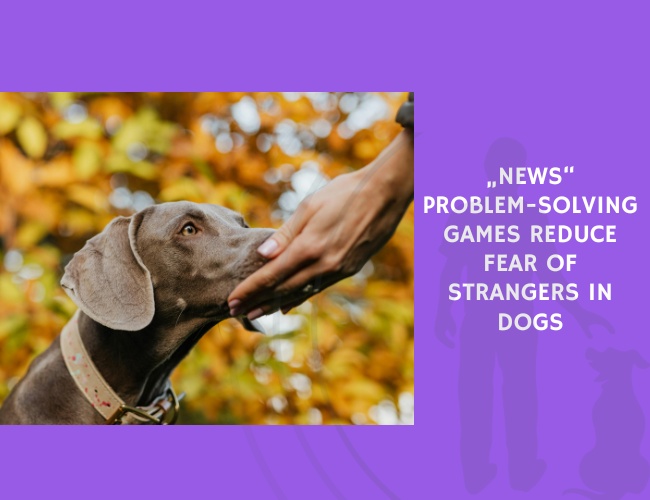
Published in 2016, this experimental study investigated the emotional effects of problem-solving sessions on dogs displaying significant social fear. The researchers aimed to test whether cognitive enrichment—through interactive tasks and puzzle-solving—could alter fearful behavioural patterns when dogs encountered unfamiliar humans. Sixteen dogs were evaluated using the Fear Behavioural Assessment (FBA), a standardized adaptation of the Dog Mentality Assessment, which measures behavioural reactions toward strangers under varying contexts.
In controlled trials, the dogs were exposed to four different subtests involving unfamiliar people (UPs): approach and leash handling, play invitation by a hooded stranger, sudden manikin appearance, and passive conversation between handler and stranger. Each dog received fear scores from trained observers on a 1–5 scale, where 1 indicated extreme fear and 5 represented calm engagement. Dogs identified as fearful were divided into two groups: a problem-solving group (n=12) and a control group (n=4). The problem-solving group participated in a series of cognitive sessions featuring games of increasing complexity across several days.
After approximately 60 days, the same FBA was repeated. The results were striking: dogs in the problem-solving group showed statistically significant improvement in their fear scores (W = -91.0, p < 0.022), while the control group showed none. Moreover, the frequency of dogs showing no timorous response (score = 5) increased from 0 to 9 (χ² = 6.37, p = 0.012). This suggests that active cognitive engagement may serve as an effective behavioural therapy tool, fostering confidence and curiosity through problem-based interaction.
Zilocchi and Carlone’s findings highlight that emotional recovery in fearful dogs does not depend solely on desensitisation or exposure but can emerge through structured cognitive activation. Problem-solving triggers dopamine-linked learning processes that reward curiosity and self-efficacy—turning what was once fear-inducing into a manageable, even enjoyable challenge. This aligns with broader insights in NeuroBond-based training, where emotional regulation through cognition replaces suppression through control.
Source: Zilocchi, M., & Carlone, B. (2016). Problem solving games as a tool to reduce fear of strangers in dogs, 2, 3–12. Published March 30, 2016.










