
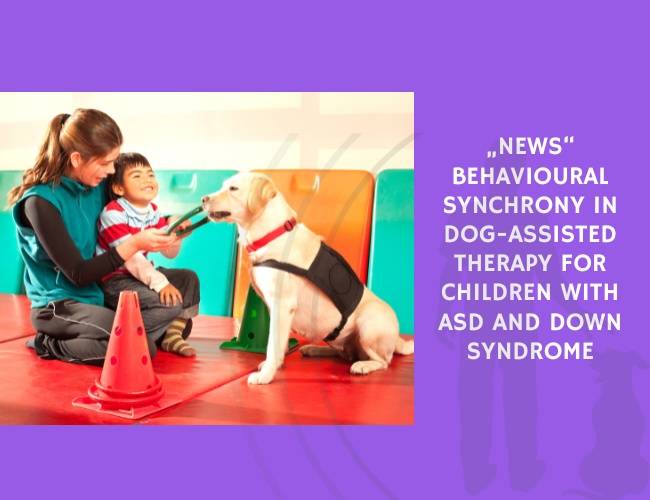
Published in the Journal of Applied Research in Intellectual Disabilities, this pioneering study investigated how movement synchrony between children and their therapy dogs changes throughout a therapy program, and how this might relate to emotional and behavioral outcomes. The researchers analyzed interactions between ten children (diagnosed with either ASD or Down syndrome) and their therapy dogs during the first and last sessions of a structured DAT program.
Findings revealed a significant increase in synchrony—the coordinated timing of movements—between the children and their dogs as the program progressed. Interestingly, children with ASD displayed stronger synchrony patterns than children with Down syndrome, suggesting a higher degree of social attunement and responsiveness to the dogs over time. These synchrony gains correlated with improvements in emotional regulation and behavior, supporting the idea that relational rhythm plays a key role in therapeutic outcomes.
The authors propose that synchrony represents a core mechanism behind the benefits of dog-assisted interventions. Rather than direct instruction or reinforcement, healing emerges through the implicit rhythm of shared behavior—an embodied dialogue that bridges the social and sensory worlds of both species. For children with ASD, who often face challenges with human-to-human synchrony, the dog’s predictable, nonjudgmental presence may provide a uniquely accessible model for emotional connection.
This study deepens our understanding of how human–animal co-regulation works, suggesting that synchrony—eye contact, movement timing, and shared stillness—may form the biological and emotional foundation of trust. Dog-assisted therapy thus becomes not just an aid, but a mirror of connection, helping children rediscover the rhythm of being understood.
Source: Griffioen, R., Steen, S., Verheggen, T., Enders-Slegers, M., & Cox, R. (2019). Changes in behavioural synchrony during dog-assisted therapy for children with autism spectrum disorder and children with Down syndrome. Journal of Applied Research in Intellectual Disabilities. Published December 6, 2019.










