
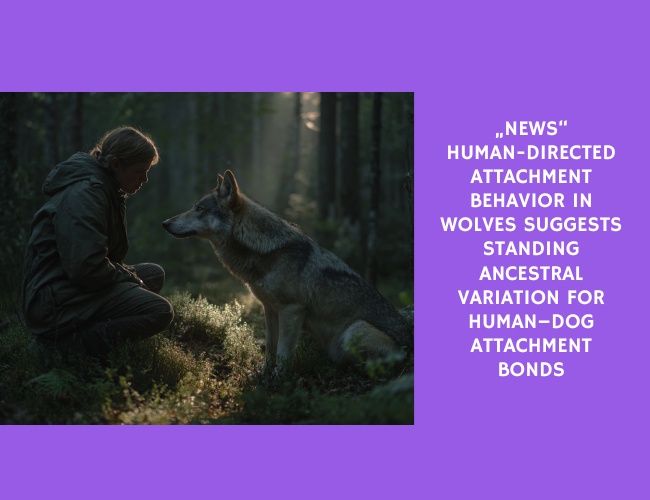
Published in Ecology and Evolution, this study challenges the long-held assumption that human-directed sociability evolved exclusively after domestication. The researchers analyzed behavioral patterns in hand-reared wolves and dogs raised under identical conditions, applying standardized attachment tests to measure stress response, proximity-seeking, and social preference when interacting with familiar humans versus strangers.
The results revealed that wolves displayed secure-base and safe-haven behaviors similar to dogs—showing comfort and reduced anxiety in the presence of their human caregiver. While individual variation was greater among wolves, their capacity for emotional bonding and social referencing mirrored the behavioral components of human–dog attachment. These findings indicate that the ability to form strong interspecies bonds was not an innovation of domestication but rather a case of ancestral standing variation within the species lineage.
Wheat and colleagues argue that domestication likely built upon this pre-existing social flexibility, amplifying emotional responsiveness and reducing fear thresholds rather than inventing attachment de novo. Their research underscores the continuity between wolf and dog cognition, reframing domestication as an evolutionary refinement of ancient affiliative potential.
This discovery enriches our understanding of emotional evolution and interspecies empathy, positioning wolves not as emotionally alien ancestors but as carriers of the same social seeds that blossomed into the dog–human partnership we know today.
Source: Wheat, C. H., Larsson, L., Berner, P., & Temrin, H. (2022). Human‐directed attachment behavior in wolves suggests standing ancestral variation for human–dog attachment bonds. Ecology and Evolution, 12. Published September 1, 2022.










