
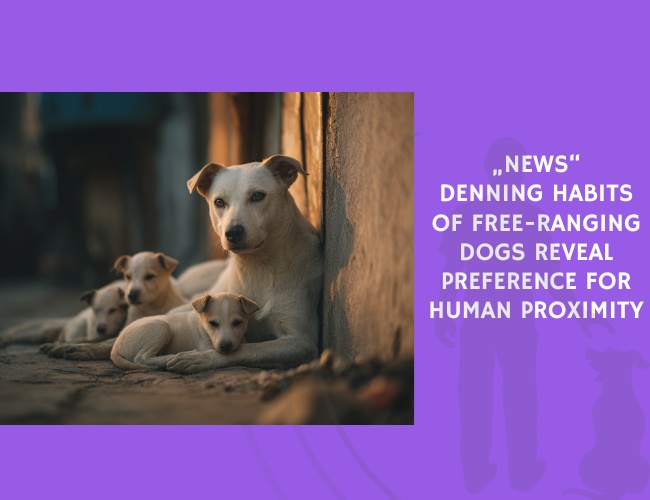
Published in Scientific Reports, this research investigated 148 den sites used by free-ranging dogs to raise their litters. Den selection, a critical aspect of parental care, is typically influenced by the availability of resources and protection from predators. Yet, unlike most wild mammals that avoid human activity, these dogs showed a marked preference for denning close to human settlements, even at the cost of potential danger from human interference.
The study found that resource accessibility—such as proximity to food waste, water, and shelter—played a decisive role in den placement. However, anthropogenic disturbance (noise, traffic, or human movement) had little deterrent effect. Despite the high rates of human-induced pup mortality, the advantages of staying near people—reliable access to food and protection from wild predators—appeared to outweigh the risks.
Majumder and colleagues proposed that this behavioral pattern represents a form of evolutionary adaptation in which generations of dogs have fine-tuned their reproductive strategies to coexist with human activity. This proximity, while dangerous, ensures a stable food source and familiarity with human cues, reinforcing the deep ecological and behavioral entanglement between humans and dogs.
The findings redefine free-ranging dogs not as outsiders to urban life, but as co-evolved participants in the urban ecosystem. Their denning choices illustrate how survival in the Anthropocene depends not on avoidance, but on strategic coexistence—a testament to the dog’s resilience and adaptive intelligence.
Source: Majumder, S. S., Paul, M., Sau, S., & Bhadra, A. (2016). Denning habits of free-ranging dogs reveal preference for human proximity. Scientific Reports, 6. Published August 18, 2016.










