
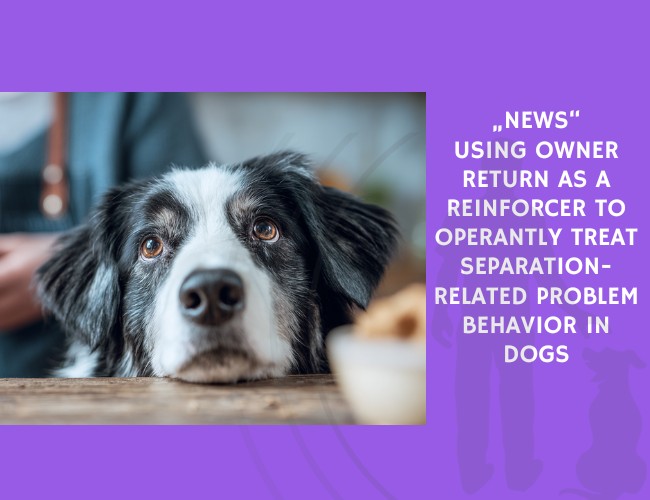
Published in Animals (MDPI), this study addressed one of the most persistent behavioral challenges in domestic dogs: distress when left alone, often manifesting as destructive behavior, excessive vocalization, or attempts to escape. Unlike traditional desensitization and habituation protocols, Feuerbacher and Muir implemented a contingent reinforcement model, rewarding dogs for remaining calm during owner absence with the return of the owner itself as the reinforcer.
The researchers conducted structured training sessions with five dogs. After establishing baseline measurements—where dogs, on average, exhibited SRPB within 27.1 seconds—they introduced a stepwise protocol. Dogs were left alone for gradually increasing durations, and owners returned only when no problem behavior or specific desired calm behavior (e.g., lying down, quiet waiting) was observed. Owners were coached to maintain consistency and timing across all trials to ensure treatment integrity.
Results showed measurable improvement: all dogs increased their ability to remain alone without displaying SRPB compared to baseline. However, the progression was slow—after four sessions, only one dog managed to stay alone for at least five minutes without distress. This finding highlights both the potential efficacy and the difficulty of operant conditioning approaches in modifying deeply rooted separation-related anxiety.
Feuerbacher and Muir concluded that contingent owner return can serve as a meaningful, emotionally relevant reinforcer, directly tying positive experiences to solitude. Nevertheless, the study underscores that patience, precision, and persistence are essential for meaningful improvement, and that future research should refine these protocols to accelerate progress and enhance generalization to real-life contexts.
Source: Feuerbacher, E. N., & Muir, K. (2020). Using Owner Return as a Reinforcer to Operantly Treat Separation-Related Problem Behavior in Dogs. Animals, 10. Published June 29, 2020.










