
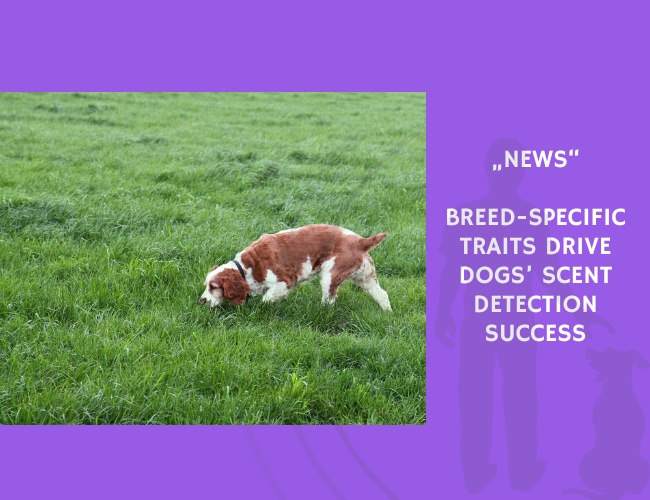
Published in Scientific Reports, Attila Salamon and colleagues investigated how breed and individual differences affect olfactory performance using a Natural Detection Task (NDT) that required no prior training. The study aimed to clarify whether breed group categories—such as those selected for olfaction, cooperation, or both—meaningfully predict dogs’ scent detection abilities.
A total of 527 dogs were tested (484 analyzed) across various breeds to measure how quickly and accurately they located hidden food rewards. Unlike conventional detection dog studies, which often involve pre-trained individuals, the NDT offered a naturalistic context to assess spontaneous scent detection behavior.
The findings revealed that breed-specific differences significantly affected olfactory success, while functional breed group classifications (e.g., hunting, herding, retrieving) were not predictive of performance. For example, Border Collies—primarily selected for herding—outperformed Golden Retrievers, Hungarian and German Vizslas, and Basset/Bloodhounds, all breeds traditionally associated with scent work. Conversely, Beagles excelled in locating hidden food faster than several other breeds, including Border Collies and Labradors.
Individual differences also played a major role. Dogs with higher Responsiveness to Training personality scores performed better, suggesting that cognitive and motivational factors influence detection ability. Interestingly, higher overall training experience correlated with slower search success, indicating that learned task structures may sometimes hinder spontaneous scent problem-solving.
Behavioral traits such as Activity/Excitability and ADHD-like scores, as well as owners’ rewarding styles, did not significantly impact olfactory success. The study’s authors highlight that complex interactions between genetic predispositions and environmental factors shape detection performance, producing large variability even within breeds.
Overall, the results challenge traditional assumptions about the superiority of “scent-oriented” breeds, suggesting that natural detection ability emerges from individual breed traits rather than group-level classifications. The use of the Natural Detection Task also proved valuable for evaluating real-world scent detection behavior, providing a framework for understanding how genetics, personality, and environment coalesce in canine olfaction.
Source: Salamon, A., Miklósi, Á., Zsiros, L. R., Kovács, T., Kubinyi, E., Andics, A., & Gácsi, M. (2025). Breed differences in olfactory performance of dogs. Scientific Reports, 15. Published January 21, 2025. https://doi.org/10.1038/s41598-025-87136-y










