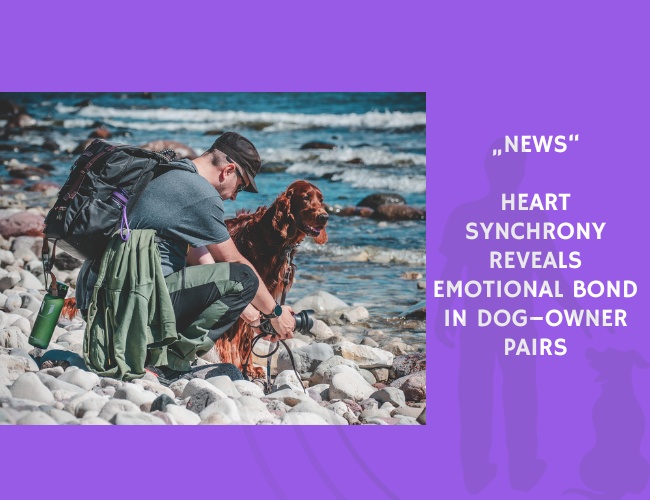
Published in Scientific Reports, the study by Aija Koskela and colleagues explored the concept of behavioral and emotional co-modulation—the dynamic synchronization of emotional and physiological states—between dogs and their human companions. Using simultaneous recordings of heart rate variability (HRV) and physical activity, the researchers examined how these parameters aligned during rest and interaction.
The pseudorandomized cross-over study involved 29 dogs from co-operative breeds and their owners. Each dog–owner pair participated in resting baselines and four distinct positive interaction tasks: Stroking, Training, Sniffing, and Playing. Additionally, surveys assessed owner temperament, dog–owner relationship quality, and ownership duration. This multi-dimensional approach allowed the team to examine both behavioral synchrony and emotional attunement across contexts.
The analyses revealed that overall HRV and activity correlated between dogs and owners, suggesting shared autonomic regulation. However, the synchronization varied by task: HRV alignment occurred primarily during free-behaving baselines (before and after structured interactions), whereas activity levels correlated during interactive tasks such as stroking and playing. This indicates that emotional alignment emerges more naturally in calm or spontaneous settings, while physical synchrony strengthens during cooperative activity.
Further modeling identified dog HRV as the only predictor of owner HRV, underscoring dogs’ potential to influence human physiology during bonding moments. Factors such as dog height, ownership duration, owner negative affectivity, and interaction quality significantly shaped the physiological responses observed. Together, these findings highlight how both individual traits and relationship dynamics contribute to emotional interdependence in dog–owner pairs.
The results reinforce that the emotional connection between dogs and their humans extends beyond behavior—it is physically measurable in the synchrony of heart rhythms and movements. This co-modulation parallels attachment mechanisms seen in human relationships, emphasizing the depth of empathy, cooperation, and shared affect within the dog–human bond. The study contributes to a growing body of evidence suggesting that inter-species companionship can shape emotional physiology in both directions.
Source: Koskela, A., Törnqvist, H., Somppi, S., Tiira, K., Kykyri, V.-L., Hänninen, L., Kujala, J., Nagasawa, M., Kikusui, T., & Kujala, M. V. (2024). Behavioral and emotional co-modulation during dog–owner interaction measured by heart rate variability and activity. Scientific Reports, 14. Published October 24, 2024.