
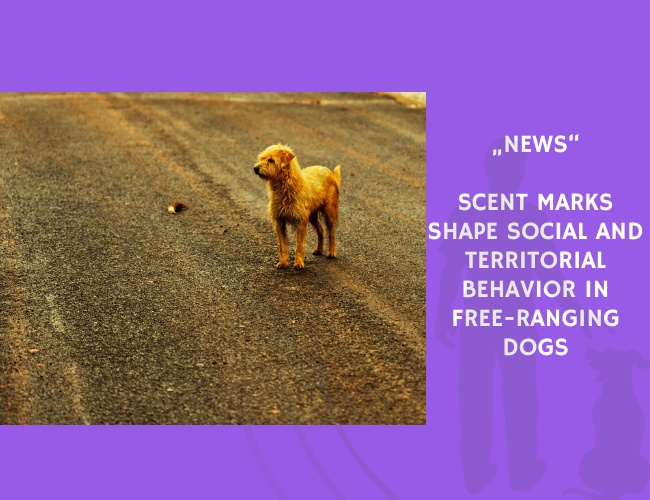
In their study published in Behavioral Ecology and Sociobiology, Sourabh Biswas and colleagues examined how free-ranging dogs use scent marking to navigate the social and territorial challenges of group living. Scent marks, consisting of urine or glandular secretions, are a fundamental mode of non-visual communication among canids, allowing individuals to signal ownership, reproductive status, and social identity. Despite extensive research on wolves and other wild canids, the complex olfactory behavior of free-ranging domestic dogs has remained underexplored.
The researchers investigated how dogs from different social groups responded to scent marks left by individuals of varying sex and group identity. Behavioral observations were conducted across strategic locations within established territories, focusing on the frequency and nature of sniffing, overmarking, and other interactive behaviors toward these scent sources. Both male and female dogs showed significantly stronger interest in scent marks compared to control sites, indicating that these chemical cues play a vital role in mediating territorial awareness and social recognition.
Interestingly, males exhibited more intense territorial behavior, often engaging in overmarking—depositing their own scent on top of another dog’s mark—to assert dominance and ownership. Overmarking was most frequently directed toward male scent marks from neighboring groups, suggesting a heightened response to potential territorial threats. Behavioral cluster analyses supported this finding, showing that neighboring-group male scents elicited the most distinct and complex reactions, blending curiosity, vigilance, and competitive posturing.
The results demonstrate that scent marking in free-ranging dogs is multifunctional: it regulates not only territorial defense but also intrasexual competition and social cohesion within groups. The study also highlights sex-based differences in olfactory communication strategies, where males tend toward dominance and boundary enforcement, while females may prioritize information gathering and social stability.
By revealing the sophisticated use of olfactory cues in free-ranging dogs, Biswas et al. deepen our understanding of canine communication in natural settings. These findings suggest that scent marks function as both social and ecological tools, maintaining order, reducing conflict, and reinforcing social hierarchies within and between dog groups.
Source: Biswas, S., Ghosh, K., Ghosh, S., Biswas, A., & Bhadra, A. (2024). What is in a scent? Understanding the role of scent marking in social dynamics and territoriality of free-ranging dogs. Behavioral Ecology and Sociobiology. Published September 18, 2024.










