
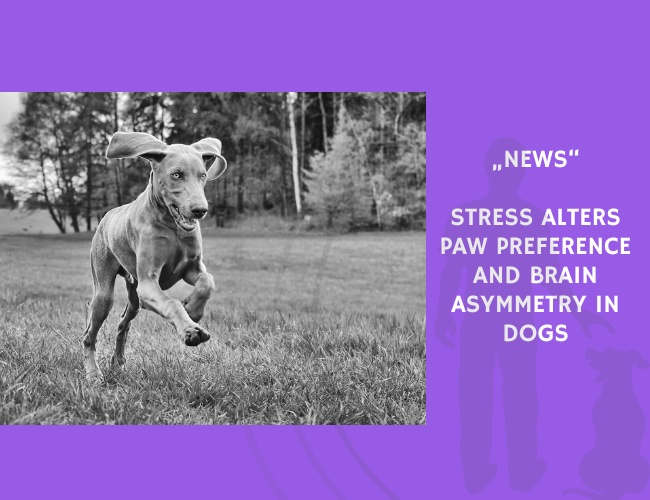
Published in Scientific Reports, this study by Yasemin Salgirli Demirbas and colleagues examined how stress influences behavioral laterality—a measure of brain asymmetry that often manifests through paw preference. Since hemispheric specialization in the brain is associated with emotion regulation and coping, understanding how stress affects laterality offers valuable insights into canine welfare and neurobiology.
The researchers tested 60 dogs (28 chronically stressed and 32 healthy) using two standardized motor laterality tasks: the Kong™ Test and the Food-Reaching Test (FRT). These were conducted in both a home environment and a stressful open field test (OFT) setting. Physiological stress indicators—salivary cortisol, heart rate, and respiratory rate—were measured to confirm stress responses during testing.
Results showed that exposure to acute stress via the OFT led to a shift toward ambilaterality—a reduction in consistent paw preference—indicating that stress disrupts normal hemispheric dominance. Dogs under chronic stress exhibited a significantly lower absolute laterality index, suggesting weakened or unstable lateralized behavior compared to healthy controls. Notably, the direction of the first paw used in the FRT accurately predicted a dog’s overall paw preference, validating the test’s reliability as a behavioral marker.
The findings provide empirical evidence that both acute and chronic stress can influence the brain’s functional asymmetry in dogs, leading to more variable or less defined behavioral patterns. This connection highlights how ongoing stress not only affects physiology and emotion but may also alter the neural balance between hemispheres.
Demirbas et al. emphasize that behavioral laterality could serve as a non-invasive indicator of stress and emotional well-being in dogs. Regular observation of changes in paw use, response patterns, or motor consistency could help veterinarians and owners detect chronic stress early, promoting timely intervention and improved welfare outcomes.
Source: Demirbas, Y. S., Isparta, S., Saral, B., Yılmaz, N. K., Adıay, D., Matsui, H., Töre-Yargın, G., Musa, S. A., Atilgan, D., Öztürk, H., Kul, B. C., Şafak, C., Ocklenburg, S., & Güntürkün, O. (2023). Acute and chronic stress alter behavioral laterality in dogs. Scientific Reports, 13. Published March 11, 2023.










