
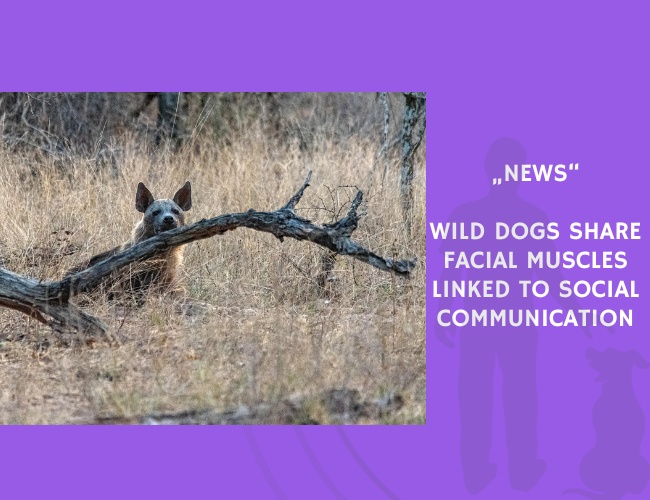
Published in The Anatomical Record, this study by Heather F. Smith and colleagues provides a rare anatomical insight into the mimetic and auricular musculature of the African wild dog. Through detailed dissections of an adult male Lycaon pictus, the researchers discovered that these highly social predators possess remarkably developed facial and ear muscles—structures crucial for both visual communication and group coordination.
The study found that two key facial muscles, the levator anguli oculi medialis (LAOM) and the retractor anguli oculi lateralis (RAOL), are enlarged and functionally significant in the African wild dog, much like in domestic dogs. These muscles, along with the orbicularis oculi, contribute to expressive eyebrow and eye movements that facilitate subtle communication during cooperative behaviors such as hunting, greeting, and conflict avoidance.
In addition to facial expressivity, the auricular (ear) musculature was found to be exceptionally well-developed, enabling fine-tuned ear positioning and rotation. This adaptation allows for enhanced auditory perception and thermoregulation—critical features for survival in the open savannah environment where acoustic and visual coordination are key to the species’ remarkable hunting success.
The findings challenge the long-held belief that expressive eye communication evolved uniquely in domestic dogs to enhance interaction with humans. Instead, Smith et al. suggest that these traits likely have deeper evolutionary roots, serving as essential components of social cohesion in ancestral canids. The study highlights that domestic dogs’ ability to communicate through gaze and expression may have been built upon pre-existing social traits present in their wild relatives.
Ultimately, this research reframes our understanding of canine communication, demonstrating that both wild and domestic dogs share neuromuscular adaptations for empathy, coordination, and social bonding—traits that have made the species such effective collaborators, whether within a pack or alongside humans.
Source: Smith, H. F., Felix, M. A., Rocco, F. A., Lynch, L. M., & Valdez, D. (2024). Adaptations to sociality in the mimetic and auricular musculature of the African wild dog (Lycaon pictus). The Anatomical Record, 307, 3327–3343. Published April 10, 2024.










