
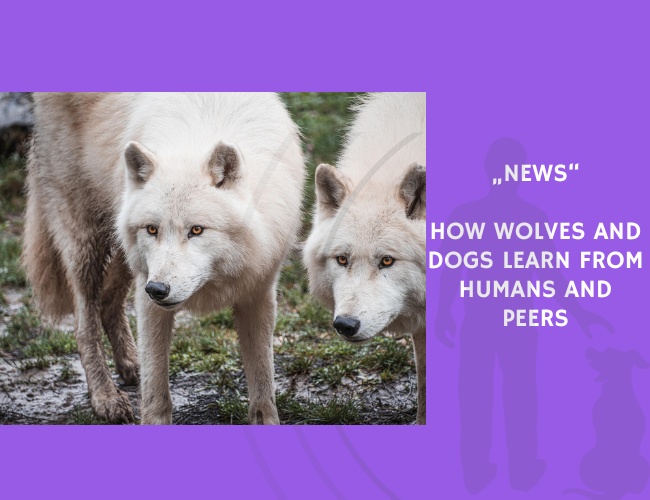
Social learning—the ability to acquire new information by observing others—is central to both human and animal societies. In a 2013 study published in Frontiers in Psychology, Friederike Range and Zsófia Virányi compared the learning abilities of identically raised wolves and dogs to determine how domestication may have shaped dogs’ sensitivity to social cues.
Both species were tested using a local enhancement task, where individuals observed a demonstrator (either a human or a conspecific) hiding food in a target location. The results revealed that both wolves and dogs benefited from social demonstrations, regardless of whether the model was human or canine. This finding challenges the idea that dogs uniquely evolved to learn from humans, instead showing that wolves also possess strong social learning capacities.
However, important differences emerged in how the two species interpreted demonstrations. When the demonstrator only pretended to hide food, dogs still differentiated between the false and true demonstrations—whether performed by a human or another dog. Wolves, on the other hand, only made this distinction when observing humans, not conspecifics. This suggests that wolves attend more to behavioral details of their peers, whereas dogs may rely more on general social cues, particularly when humans are involved.
Range and Virányi propose that these differences reflect subtle effects of domestication: dogs have become more attuned to human intentions and cues, while wolves retain a more analytic attention to detail within their own species’ communication. Both species, however, demonstrate flexible cognitive mechanisms that enable them to learn across social contexts.
The study underscores that domestication did not create dogs’ social learning abilities but rather refined their focus toward human partners. This nuanced understanding of social cognition helps explain why dogs are exceptional at interpreting human gestures, tone, and emotional signals while still sharing deep behavioral roots with their wolf ancestors.
Source: Range, F., & Virányi, Z. (2013). Social Learning from Humans or Conspecifics: Differences and Similarities between Wolves and Dogs. Frontiers in Psychology, 4. Published December 3, 2013.










