
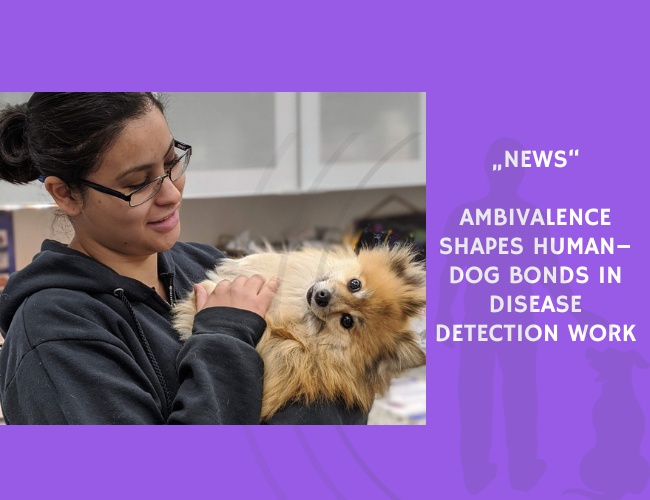
Dogs’ extraordinary olfactory abilities have led to their use in detecting a range of human diseases, from cancer to viral infections. In her 2021 ethnographic study published in Anthrozoös, Katrina E. Holland examined how the training and collaboration between humans and medical detection dogs produce both scientific knowledge and deep emotional complexity. Through participant observation and interviews at two detection-dog research facilities, Holland explored the interspecies relationships and affective exchanges that occur during this specialized work.
The study highlights a central tension in how trainers perceive their canine collaborators. On one hand, the dogs are regarded as precise diagnostic instruments—biological sensors capable of detecting chemical cues imperceptible to humans. On the other, they are acknowledged as sentient individuals with emotions, motivations, and agency that can make their responses unpredictable. Trainers navigate this duality through a form of “interpretive listening,” learning to read subtle shifts in canine behavior and to respond with empathy and adaptability.
Holland found that this mutual process of learning and adjustment blurs traditional boundaries between human and animal expertise. Knowledge in this field is co-created through interspecies cooperation, even as structural hierarchies persist—trainers ultimately control the learning environment and interpret the dogs’ performance. The study describes these encounters as mutually affective, with both dogs and humans undergoing emotional and behavioral transformation through their collaboration.
By positioning ambivalence not as a flaw but as an integral part of human–animal cooperation, Holland’s work deepens understanding of how empathy, uncertainty, and respect shape successful working partnerships between species. Her findings underscore that scientific precision in detection dog work depends not only on canine skill but also on human emotional attunement and interpretive flexibility.
Source: Holland, K. E. (2021). Ambiguity, Ambivalence, and Affective Encounters: An Ethnographic Account of Medical Detection Dog–Trainer Relationships. Anthrozoös, 35, 259–271. Published September 22, 2021.










