
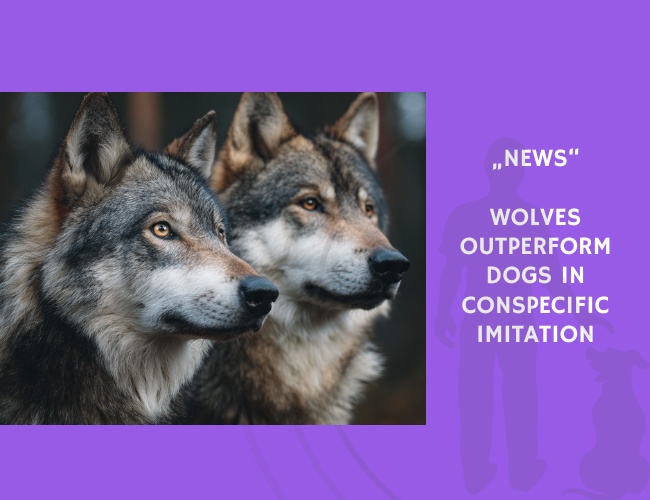
Domestication theories often emphasize how dogs evolved enhanced cognitive and communicative skills to interact with humans. However, little is known about how domestication affected their interactions with conspecifics. The cooperative breeding hypothesis suggests that wolves’ reliance on group hunting, breeding, and territory defense created selection pressures for close coordination and social learning.
Range and Virányi (2014) tested 6-month-old wolves and dogs in a two-action imitation task following a conspecific demonstration. The results were striking: wolves successfully solved the problem after watching the demonstration, while dogs of the same age failed. This could not be explained by differences in motivation, physical insight, or developmental trajectories.
The findings suggest that wolves’ stronger cooperativeness goes hand in hand with their heightened attention to the detailed actions of others. By contrast, dogs’ reduced reliance on conspecific cooperation—shaped by domestication—may have lessened these skills. Importantly, the study offers an alternative view of domestication: wolves’ cooperative tendencies may have laid the foundation for dog–human cooperation, rather than being replaced by them.
Overall, the study highlights that wolves excel at conspecific imitation, underscoring the evolutionary importance of social learning in shaping both wolf packs and the dog–human bond.
Source: Range, F., & Virányi, Z. (2014). Wolves Are Better Imitators of Conspecifics than Dogs. PLoS ONE, 9, published January 29, 2014.










