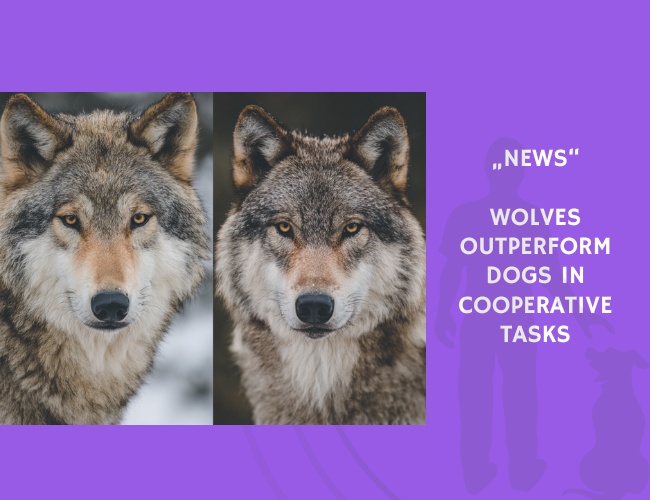
Domestication theories have suggested that dogs evolved to be more tolerant and cooperative than wolves. However, the distinct social ecologies of the two species challenge this assumption. Wolves depend heavily on conspecific cooperation, while dogs rely more on human partnerships, potentially shaping their cooperative tendencies differently.
Marshall-Pescini and colleagues (2018) tested wolves and dogs in a cooperative string-pulling task that required two individuals to pull simultaneously to move a tray of food. Wolves consistently outperformed dogs, demonstrating higher rates of successful cooperation. Dogs often failed due to tolerance issues, such as one partner disengaging when the other was active, rather than a lack of cognitive ability.
To test whether experience improved performance, one member of each dog dyad was trained as an “expert” partner. While this boosted cooperation compared to inexperienced dog pairs, their success still lagged behind wolf dyads with equivalent training. The results emphasize that wolves’ social reliance on pack cooperation translates into superior problem-solving teamwork.
Interestingly, social rank influenced cooperation differently across species. For dogs, partners further apart in rank cooperated better, while in wolves, closer rank proximity improved success. These findings highlight the impact of species-specific social structures on cooperative strategies.
Overall, the study underscores that wolves’ cooperative skills are rooted in their ecology, while dogs’ domestication has shifted their reliance from conspecific teamwork to human partnership.
Source: Marshall-Pescini, S., Basin, C., & Range, F. (2018). A task-experienced partner does not help dogs be as successful as wolves in a cooperative string-pulling task. Scientific Reports, 8, published October 30, 2018.