

Introduction: The Sound That Changes Nothing
You’ve said it a thousand times. “No.” Maybe you’ve said it firmly, gently, or with rising frustration as your dog continues doing exactly what you don’t want. Yet somehow, that simple word seems to dissolve into the air, leaving your furry friend confused and you feeling unheard.
Here’s the truth: “No” isn’t failing because your dog is stubborn or defiant. It’s failing because, from a neurocognitive perspective, your dog’s brain simply cannot process what “No” actually means in terms of actionable behavior. When we understand how dogs process human communication, interpret emotional signals, and form memories around learning experiences, we discover something profound—the word “No” creates conflict where clarity should live.
Let us guide you through the science of why this single syllable undermines training, damages trust, and what you can offer instead. This isn’t about being “too soft” or permissive. It’s about working with your dog’s cognitive architecture rather than against it. Through the NeuroBond approach, trust becomes the foundation of learning, not fear or confusion. 🧡
Understanding Canine Cognitive Processing
How Dogs Interpret Human Communication
Your dog watches you constantly, reading not just your words but your entire being. Dogs have evolved alongside humans for thousands of years, developing an extraordinary ability to interpret our communicative cues. They look to our faces, our gestures, our tone, and even our scent to understand what we’re asking of them.
Research reveals that dogs expect human communication to be clear, informative, and easy to process. When you give effective cues, your dog can:
- Quickly understand what action you’re requesting
- Process the information without emotional interference
- Connect the cue to a specific, achievable behavior
- Experience success and receive reinforcement
- Build confidence through repeated clarity
The word “No” violates every principle of effective canine communication. It tells your dog what to stop, but offers no information about what to do instead. Imagine someone shouting “Wrong!” at you repeatedly without ever showing you the right answer. That’s the cognitive load “No” places on your dog’s mind.
The Amygdala Response: When Correction Becomes Threat
Inside your dog’s brain, a small almond-shaped structure called the amygdala acts as an emotional alarm system. This region responds to emotionally arousing stimuli, regardless of whether they’re positive or negative. When you say “No” with an angry, frustrated, or sharp tone, your dog’s amygdala lights up—not with understanding, but with threat assessment.
This activation triggers the sympathetic nervous system. Heart rate increases. Stress hormones begin flowing. Your dog’s cognitive resources shift from learning mode to survival mode. Instead of thinking “What should I do differently?” your dog is processing “Am I safe right now?”
The amygdala’s response is automatic and powerful. It doesn’t distinguish between a genuine threat and a harsh verbal cue. Both register as potentially dangerous, diverting your dog’s attention away from the lesson you’re trying to teach and toward self-protection.
Processing Costs vs. Cognitive Benefits
Dogs, like human toddlers, approach new communicative cues with an expectation: cues should have low processing costs and high cognitive benefits. In simpler terms, your dog expects that when you communicate, the message will be easy to understand and contain useful information.
“No” has high processing costs because it’s ambiguous. Your dog must stop what they’re doing, but without guidance on the alternative, they’re left guessing. Is jumping wrong always, or just right now? Should they sit, lie down, or move away? The cognitive effort required to decode “No” is substantial, and the informational reward is minimal.
Compare this to “Sit.” One word, one clear action, one opportunity for success. The processing cost is low, the cognitive benefit is high, and your dog can immediately demonstrate understanding. This is the kind of communication that builds confidence and strengthens the bond between you. 🧠
The Emotional and Physiological Impact of “No”
Stress Markers and the Canine Body
Your dog’s body responds to verbal punishment in measurable ways. When dogs hear harsh verbal corrections, especially delivered with anger or frustration, their bodies enter a state of physiological stress. The hypothalamus, a region of the brain that regulates stress responses, activates alongside the amygdala.
This activation cascades through the body. Autonomic reactivity increases—heart rate accelerates, skin conductance changes, and breathing may become shallow or rapid. These are the same physiological markers we see when dogs encounter genuinely threatening situations.
Physical signs of stress you might notice include:
- Rapid panting or changes in breathing patterns
- Dilated pupils and wide, worried eyes
- Tense body posture with weight shifted back
- Tucked tail or low tail carriage
- Lip licking, yawning, or other displacement behaviors
- Sweaty paw prints (dogs sweat through their paws)
- Trembling or shaking
- Avoidance behaviors like turning away or hiding
Perhaps most fascinating is recent research showing that dogs can detect human stress through olfactory cues alone. When you’re frustrated and repeatedly saying “No,” your dog can literally smell your stress. This olfactory information affects their cognition and learning, potentially triggering risk-reduction behaviors where your dog becomes more cautious, less explorative, and less willing to try new behaviors.
The stress response isn’t just uncomfortable for your dog—it actively interferes with learning. A brain in survival mode cannot effectively encode new information or practice problem-solving. You might get momentary compliance through intimidation, but you won’t get understanding or lasting behavioral change.
Emotional Contagion: When Your Tension Becomes Theirs
You’ve probably noticed this yourself: when you’re anxious, your dog seems anxious too. When you’re calm, they settle more easily. This phenomenon is called emotional contagion, and it’s a powerful force in the dog-human relationship.
Dogs mirror owner tension. If you deliver “No” with rising frustration after your dog has ignored you multiple times, that frustration transfers to your dog. They don’t just hear the word—they feel your emotional state and internalize it.
This emotional mirroring means that conflict-based corrections create a feedback loop. Your dog does something unwanted, you say “No” with frustration, your dog feels your tension and becomes anxious, the anxiety makes learning harder, the behavior continues, your frustration grows, and the cycle intensifies.
Breaking this cycle requires understanding that your emotional regulation directly shapes your dog’s learning environment. The Invisible Leash reminds us that awareness, not tension, guides the path. When you approach corrections with calm clarity rather than emotional charge, you create space for your dog to actually learn. �
The Erosion of Trust and Bond
Trust between you and your dog is built on predictability, safety, and positive interaction. Each time you interact with your dog, you’re making a deposit or withdrawal from your relationship’s trust account.
Consistent use of “No,” especially when delivered unpredictably or with varying emotional intensity, makes withdrawals. Your dog begins to perceive interactions as risky rather than rewarding. The “first-impression hypothesis” suggests that dogs initially respond positively to facilitate bonding, then adjust their preferences based on perceived risk and benefit. If corrections dominate your communication, the risk-benefit calculation shifts unfavorably.
Consider oxytocin, often called the bonding hormone. This neurochemical is released during positive social interactions and strengthens the dog-human bond. Oxytocin helps dogs interpret human communication signals more effectively. Conflict-based interactions, however, disrupt this system. While research hasn’t directly measured oxytocin levels during verbal corrections, we can reasonably infer that negative interactions don’t trigger the oxytocin release that positive, affiliative behaviors do.
Over time, repeated negative verbal cues can fundamentally alter how your dog perceives you—not as a trusted guide, but as an unpredictable source of stress. This erosion of trust makes every aspect of training harder and diminishes the joy that should define your relationship.
Learned Helplessness and Frustration
When Correction Without Direction Creates Passivity
Learned helplessness is a psychological state where an individual stops trying to avoid negative situations because they’ve learned that nothing they do makes a difference. This phenomenon, first documented in animal research, occurs when negative stimuli are inescapable and unpredictable.
If your dog repeatedly hears “No” without understanding what behavior would earn your approval, they may begin to experience a version of learned helplessness. They’re being told they’re wrong, but never shown how to be right. Over time, this can lead to a dog who stops trying, becomes passive, or develops anxiety around training situations.
You might notice this as a dog who “shuts down” during training, showing signs like avoiding eye contact, moving slowly, or refusing to engage. This isn’t defiance—it’s a dog who has learned that their actions consistently lead to negative feedback without a clear path to success.
The tragedy of learned helplessness is that it affects dogs who are trying their hardest to please you. These dogs become prisoners of confusion, trapped between the desire to do right and the inability to understand what right looks like.
Frustration Tolerance and Problem-Solving Abilities
Frustration tolerance is a measurable behavioral trait in dogs. Some dogs naturally handle frustration better than others, but unclear corrections reduce frustration tolerance across the board.
When you say “No” to a behavior, you’re inhibiting your dog’s current action without providing an acceptable alternative. This creates frustration because your dog is blocked from doing what they want, but not guided toward what they could do instead. Think of it like being told “Wrong!” on every math problem without being taught the formula.
This frustration has real cognitive consequences. Dogs experiencing frustration show reduced focus and impaired problem-solving abilities. Psychological stress affects cognition, making it harder for your dog to think through situations and make good choices.
Frustration also affects self-control. Research shows that dogs with high levels of reactivity demonstrate impaired self-control abilities, including reduced tolerance for delayed rewards. A frustrated dog is not a dog primed for learning—they’re a dog struggling to manage their emotional state while simultaneously trying to decode your expectations.
Moments of Soul Recall reveal how memory and emotion intertwine in behavior. If your dog’s strongest memories of training involve frustration and confusion, those emotional imprints will shape future learning experiences, making each new lesson harder to absorb. 😄

Learning Theory: Why Clarity Outperforms Inhibition
The Fundamental Principles of Operant Conditioning
Understanding how dogs learn requires a quick dive into learning theory. Operant conditioning, the foundation of modern dog training, involves four key principles:
Positive Reinforcement: Adding something pleasant to increase a behavior (giving a treat when your dog sits)
Negative Reinforcement: Removing something unpleasant to increase a behavior (releasing leash pressure when your dog stops pulling)
Positive Punishment: Adding something unpleasant to decrease a behavior (saying “No” when your dog jumps)
Negative Punishment: Removing something pleasant to decrease a behavior (turning away when your dog jumps, removing your attention)
While all four quadrants can modify behavior, they’re not equally effective for long-term learning and relationship building. Punishment-based methods, including verbal corrections like “No,” may create short-term behavior suppression, but they don’t teach alternative behaviors and can decrease autonomy and confidence.
The most effective training focuses on positive reinforcement—showing your dog what to do and rewarding them when they do it. This creates a learning environment where your dog is motivated to figure out what earns rewards rather than fearful of what earns correction.
Replacement Behaviors: The Power of Teaching What to Do
Instead of telling your dog “No” when they jump on guests, what if you taught them that sitting earns attention? This is the concept of replacement behaviors—providing a clear, desirable alternative to the unwanted action.
Replacement behaviors work because they satisfy your dog’s underlying motivation while channeling it into an acceptable form. Your dog jumps because they want attention. Teaching them that sitting gets attention more reliably transforms the same motivation into a behavior you actually want.
This approach aligns perfectly with how dogs naturally learn. When a behavior is reinforced, it increases. When a behavior is ignored or replaced with a more rewarding alternative, it decreases. You’re working with your dog’s learning system, not against it.
Replacement behaviors also reduce frustration because your dog always knows what success looks like. They’re never left guessing. Every interaction becomes an opportunity to practice the right choice and earn reinforcement, building confidence and strengthening your bond.
The Role of Clear Communication in Memory Formation
How your dog forms memories during training determines what they’ll remember and repeat. Memory formation is strongest when experiences are clear, emotionally positive, and consistently reinforced.
When you teach a replacement behavior with a calm tone and positive reinforcement, you’re creating a memory that includes the behavior, the context, the emotional experience, and the reward. This rich memory structure makes the behavior easy to recall and repeat.
Contrast this with “No.” The memory associated with “No” includes confusion about what was wrong, the emotional stress of correction, and no clear alternative. This memory structure is weak and difficult to generalize across situations.
Emotional consistency matters enormously here. When you maintain calm, predictable emotional states during training, your dog can focus their cognitive resources on learning rather than managing anxiety. The predictability itself becomes rewarding, as your dog learns they can trust you to be a stable, safe presence. 🧡
Proactive Guidance: A Better Approach
Pattern Interruption and Redirection
Instead of verbal correction, effective training uses pattern interruption and redirection. This means catching your dog before the unwanted behavior fully develops and redirecting their attention and energy toward something acceptable.
Pattern interruption might look like making a kissing sound or saying your dog’s name (in a neutral, attention-getting tone) the moment you see them preparing to jump on a guest. This interrupts the behavior chain before it completes.
Immediately following the interruption, you redirect: “Sit!” or guide them to their bed, or ask for a different behavior entirely. The key is that the redirection gives your dog something to do—an outlet for their energy and a path to success.
This approach manipulates antecedents (preventing the unwanted behavior before it occurs) and teaches alternatives (showing what to do instead). Both strategies are far more effective than simply suppressing behavior after it happens.
Manipulating Antecedents: Setting Your Dog Up for Success
The best training prevents problems before they occur. This is called antecedent manipulation—changing the environment or circumstances that trigger unwanted behaviors.
If your dog counter-surfs when you’re cooking, antecedent manipulation might involve:
- Keeping tempting food farther from the edge
- Placing your dog in a mat-stay position during meal prep
- Feeding your dog before you cook so they’re less motivated by hunger
- Teaching an incompatible behavior like lying on their bed while you work
By controlling antecedents, you reduce the number of times your dog has the opportunity to practice unwanted behaviors. Each repetition of a behavior strengthens it, so prevention is genuinely more effective than correction.
This proactive approach also reduces the need for any corrections, making your training sessions more positive for both of you. Your dog experiences more success, builds more confidence, and your relationship strengthens through collaboration rather than conflict.
Building Communication Models Based on Predictability and Safety
The most effective dog-human communication mirrors principles observed in other trust-based relationships: transparency, predictability, and safety create the foundation for cooperation.
Transparency means your communication is clear and honest. You don’t trick your dog or use bait-and-switch tactics. When you give a cue, your dog knows what you expect.
Predictability means your responses are consistent. “Sit” always means the same thing. Jumping on guests never works, but sitting always does. This consistency allows your dog to build reliable mental models of cause and effect.
Safety means your dog never fears you or your reactions. They may sometimes be disappointed (when you use negative punishment like removing attention), but they never feel threatened. This emotional safety is essential for the kind of open, exploratory learning that builds true understanding.
These principles align with the theoretical framework of social referencing, where dogs depend on human tone and body language to infer meaning from ambiguous situations. When your communication is transparent, predictable, and safe, your dog can relax into learning because they trust you to guide them clearly. The Invisible Leash reminds us that true guidance comes not from force or harshness, but from this foundation of mutual understanding and respect. 🧠
Emotional Regulation for Owners: The Missing Piece
Recognizing Your Own Stress Responses
Before you can help your dog regulate their emotions, you must learn to regulate your own. This might be the most challenging aspect of effective training, but it’s also one of the most transformative.
Notice what happens in your body when your dog repeats an unwanted behavior. Does your jaw tighten? Do your shoulders rise? Does your breathing become shallow? These physical signals indicate rising stress, and your dog is reading every one of them.
Your dog can detect stress through multiple channels: your body language, your tone, your facial expression, and even your scent. When you’re frustrated, you’re broadcasting that emotion, and your dog receives it as information about their environment: “My human is stressed. Something must be wrong. I need to be careful.”
Recognizing your own stress responses is the first step toward managing them. Self-awareness allows you to pause, breathe, and choose your response rather than reacting automatically. This pause—this moment of conscious choice—transforms your training from reactive to responsive.
Techniques for Staying Calm During Challenging Behaviors
When your dog is doing something that frustrates you, try these emotional regulation techniques:
Breathe Deeply: Take three slow, deep breaths before responding. This activates your parasympathetic nervous system, counteracting the stress response and giving you time to think clearly.
Reframe the Behavior: Instead of thinking “My dog is being bad,” try “My dog doesn’t understand what I want yet.” This cognitive reframing reduces frustration and helps you approach the situation as a teaching opportunity.
Use Neutral Language: Practice saying your dog’s name or attention cues in a neutral, even pleasant tone—even when you’re frustrated. This breaks the pattern of emotional charge entering your communication.
Take a Break: If you feel yourself getting genuinely angry or overwhelmed, it’s okay to put your dog in a safe space and step away. Training when you’re dysregulated does more harm than good.
Practice Gratitude: Before training sessions, spend a moment appreciating something about your dog—their enthusiasm, their loyalty, their beautiful eyes. Starting from a place of appreciation changes your entire emotional baseline.
These techniques aren’t just good for your dog—they’re good for you. Managing your emotional state reduces your stress levels, improves your overall relationship with your dog, and makes training sessions something you both enjoy rather than dread.
How Your Calm Creates Their Confidence
Your emotional state is contagious. When you approach training with calm confidence, your dog absorbs that emotional tone and reflects it back. They learn that training situations are safe, predictable, and opportunities for success.
This calm confidence becomes particularly important when teaching new behaviors or working through challenges. If you remain regulated even when your dog struggles, you send a powerful message: “I believe in you. This is safe. You can figure this out.”
Over time, your emotional regulation builds your dog’s frustration tolerance and resilience. They learn that mistakes are okay, that learning involves trial and error, and that they can trust you to guide them through uncertainty without anger or disappointment.
That balance between science and soul—between understanding the neuroscience of learning and honoring the emotional connection between you—that’s the essence of Zoeta Dogsoul. When you regulate your emotions, you create space for your dog’s intelligence and desire to please to shine through. You become partners in learning rather than adversaries in conflict. 🧡
Practical Applications: What to Say Instead of “No”
Replacement Cues That Work
So what do you say instead of “No”? The answer depends on the situation, but the principle remains constant: redirect to a behavior you want rather than simply inhibiting what you don’t.
Instead of: “No” when your dog jumps on guests
Try: “Sit” or “Place” (sending them to their bed)
Instead of: “No” when your dog pulls on the leash
Try: Stop walking and wait for a loose leash, then “Let’s go” when they check in with you
Instead of: “No” when your dog barks at the window
Try: Their name to get attention, then “Come” or “Quiet” followed immediately by a reward when they comply
Instead of: “No” when your dog chews furniture
Try: Redirect to an appropriate chew toy and praise when they take it
Instead of: “No” when your dog begs at the table
Try: “Place” before meals, teaching them that lying on their bed during dinner earns rewards
Each replacement cue provides clear direction. Your dog knows exactly what to do, can immediately perform the behavior, and receives reinforcement when they comply. This creates a positive feedback loop of success.
Teaching “Leave It” and “Drop It” as Clear Alternatives
Two of the most useful commands for replacing “No” are “Leave It” and “Drop It.” These cues are specific, teachable, and incredibly practical.
“Leave It” means “don’t touch that thing” or “move away from that thing.” You can teach this by:
- Holding a treat in your closed fist
- Waiting for your dog to stop pawing at it and look at you
- Saying “Yes!” and rewarding from your other hand
- Gradually increasing difficulty by placing treats on the floor, then using more tempting items
“Drop It” means “release what’s in your mouth.” You can teach this by:
- Playing with a toy your dog enjoys
- Offering a high-value treat near their nose
- When they open their mouth to take the treat, saying “Drop it”
- Giving the treat and praising warmly
- Returning the toy to keep the game fun
Both commands give your dog clear instructions they can follow successfully. They replace the vague prohibition of “No” with specific, actionable behaviors that work across many situations.
Using Your Dog’s Name as an Attention-Getter, Not a Correction
Your dog’s name should be the most positive sound they hear—a signal that something good is about to happen or that you need their attention for something interesting.
Unfortunately, many people use their dog’s name as a correction: “Buddy, NO!” This creates negative associations with the name itself, making your dog less likely to respond enthusiastically when you call them.
Instead, use your dog’s name purely as an attention-getter:
- Say their name in a bright, neutral tone
- Wait for them to look at you
- Immediately follow with either a cue (“Sit!”) or a reward for checking in
- Keep the emotional tone positive or neutral, never angry
When your dog hears their name and looks at you, that attention itself can be the pattern interrupt you need. Once you have their focus, you can redirect to any behavior you choose. This keeps their name associated with engagement and cooperation rather than with correction or conflict. 😄
Real-World Scenarios: Clarity in Action
Scenario One: Jumping on Guests
The “No” Approach:
Your doorbell rings. Your dog rushes to the door, excited. Guests enter, and your dog jumps on them. You say “No! Down!” Your dog drops down momentarily, then jumps again. You say “No!” more firmly. Your dog looks confused, continues jumping. You grab their collar and pull them back, repeating “No!” Your guests look uncomfortable. Your dog is now anxious and overstimulated.
The Clarity Approach:
Before guests arrive, you practice having your dog go to their “place” (a bed or mat near the door). When the doorbell rings, you calmly say “Place” and guide your dog there. You reward them for staying. Guests enter. If your dog breaks from place, you simply block access to guests with your body and redirect: “Place.” Once your dog settles, you invite guests to greet them calmly. Throughout, your tone remains neutral and your instructions are clear. Your dog knows exactly what earns rewards (staying on place) and what doesn’t work (jumping). Success builds on success.
The difference? In the first scenario, your dog experiences confusion, frustration, and stress. In the second, they have a job to do, clear feedback, and opportunities for reinforcement. The emotional experience is completely different, and so is the outcome.
Scenario Two: Counter Surfing in the Kitchen
The “No” Approach:
You’re preparing dinner. Your dog’s nose goes up toward the counter. You say “No!” They back off momentarily, then try again from a different angle. “No!” You turn back to cooking. Seconds later, your dog successfully grabs food from the counter. You yell “NO!” and chase them. Your dog thinks this is a fun game and does it again tomorrow.
The Clarity Approach:
Before cooking, you send your dog to their bed with a long-lasting chew. You’ve set up the environment so tempting items aren’t near counter edges. If your dog gets up and approaches, you calmly interrupt with their name, then redirect: “Bed.” When they return to bed, you drop a treat there without fanfare. You’ve made staying on bed more rewarding than counter surfing. Over time, your dog chooses bed automatically because that’s where good things happen.
By manipulating antecedents (removing temptation, providing an alternative activity) and reinforcing the replacement behavior (staying on bed), you prevent the unwanted behavior while teaching a desirable one. No conflict, no confusion, just clear expectations and consistent reinforcement. 🧡
Scenario Three: Leash Pulling on Walks
The “No” Approach:
Your dog pulls ahead on the leash. You say “No!” and pull back. Your dog pulls again. “No!” You yank the leash. Your dog pulls harder, now stressed and in opposition reflex (the natural tendency to pull against pressure). The walk becomes a battle. Both of you return home frustrated.
The Clarity Approach:
When your dog pulls, you simply stop walking. You wait silently. When the leash loosens—even slightly—you say “Yes!” warmly and resume walking. If your dog checks in with you voluntarily, you enthusiastically reward that. You’ve taught your dog that pulling makes everything stop (negative punishment) and that loose-leash walking or checking in makes walks continue (positive reinforcement). Your dog learns through clear cause-and-effect rather than conflict. Walks become collaborative.
The Invisible Leash isn’t just philosophical—it’s practical. When you guide through awareness and clear feedback rather than through tension and correction, your dog becomes your willing partner. They want to stay connected with you because that connection predicts good things.
Conflict. Confusion. Clarity.
“No” stops sound but not behavior. The word demands inhibition without direction, leaving the dog suspended between tension and uncertainty. What feels corrective to you feels meaningless to them.
Emotion replaces comprehension. Sharp tones trigger the amygdala, shifting the brain from learning to survival. Stress chemistry floods the body, trading understanding for vigilance.
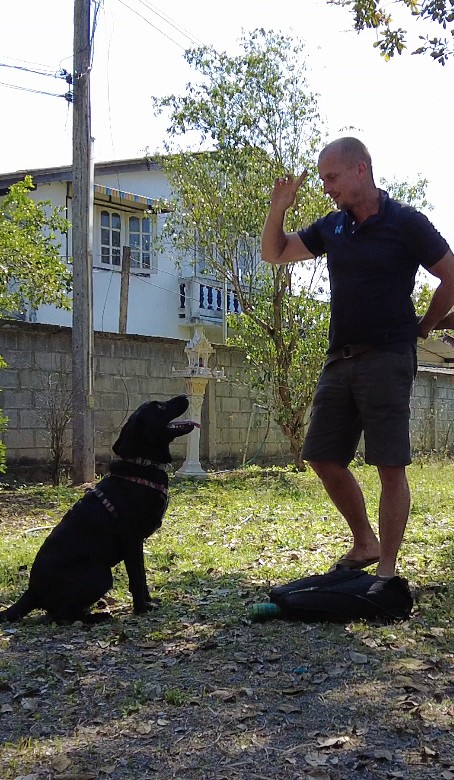


Guidance transforms reaction into trust. Replacing “No” with actionable cues—“Leave it,” “Come,” “Sit”—redirects energy into success. When clarity replaces conflict, obedience becomes communication, not fear.
The Neuroscience of Trust-Based Training
How Positive Experiences Reshape the Brain
Your dog’s brain is constantly changing based on experience. This neuroplasticity means that every interaction shapes your dog’s neural pathways, strengthening some connections and weakening others.
When your dog experiences positive training—clear cues, successful responses, and pleasant consequences—their brain forms strong associations between the behavior, the context, and the reward. The hippocampus, involved in memory formation, encodes this as a positive experience worth repeating.
Positive experiences also promote the release of dopamine, a neurotransmitter associated with motivation and reward. Dopamine not only makes your dog feel good, it strengthens the neural connections involved in the behavior, making it more likely to occur again. This is learning at its most fundamental level.
Repeated positive experiences build what we might call “confidence circuits” in your dog’s brain. They learn that trying new behaviors is safe, that interactions with you are rewarding, and that they have agency in earning good outcomes. This creates a dog who is engaged, willing to problem-solve, and emotionally resilient.
Oxytocin and the Bonding Cycle
The neurochemical oxytocin plays a remarkable role in the dog-human bond. Often called the “love hormone,” oxytocin is released during positive social interactions, including gentle petting, play, and mutual gaze between dogs and their people.
Oxytocin creates a positive feedback loop. When you interact positively with your dog, both of your bodies release oxytocin. This creates feelings of warmth, trust, and connection, which makes you both more likely to seek out positive interaction again. The hormone also enhances your dog’s ability to read and respond to your social cues, improving communication.
Conflict-based training disrupts this cycle. When interactions are characterized by correction, stress, and negative emotion, oxytocin release is suppressed. The bonding cycle breaks, and you lose one of nature’s most powerful tools for building connection and cooperation.
Trust-based training that emphasizes clarity, positive reinforcement, and emotional regulation keeps the oxytocin flowing. Each successful interaction strengthens your bond at a neurochemical level, making every subsequent training session more effective. Through the NeuroBond approach, trust becomes the foundation of learning—and that trust is literally written into your brain chemistry and your dog’s. 🧠
Stress Hormones vs. Learning Hormones
Your dog’s hormonal state determines their capacity to learn. When your dog is relaxed and engaged, their body produces hormones that support learning and memory formation. When they’re stressed, the hormonal profile shifts toward survival and self-protection.
Cortisol, the primary stress hormone, is released when your dog experiences threat or uncertainty. While short-term cortisol spikes are normal and not harmful, chronic elevation of cortisol impairs cognitive function, disrupts memory formation, and suppresses immune function. Dogs living in high-stress training environments show elevated baseline cortisol levels.
In contrast, positive training environments promote the release of hormones that support learning. Dopamine, as mentioned, enhances motivation and reinforces successful behaviors. Endorphins create feelings of pleasure and well-being. These hormones don’t just make training more pleasant—they make it more effective.
The hormonal environment of learning matters. When you choose clarity over conflict, you’re not just being nicer—you’re creating the optimal biochemical conditions for your dog’s brain to encode, consolidate, and retrieve new information. You’re literally optimizing their neurobiology for success. 🧡
Addressing Common Concerns and Misconceptions
“Won’t My Dog Walk All Over Me Without Correction?”
This is perhaps the most common concern when people first learn about positive training methods. The worry is understandable but based on a misunderstanding of how dogs learn and what motivates them.
Dogs don’t respect you because you correct them. They cooperate with you because you’ve built a relationship where cooperation is rewarding and makes sense. When you teach clear behaviors, reinforce them consistently, and manage your dog’s environment appropriately, you’re not being permissive—you’re being effective.
Setting boundaries doesn’t require verbal correction. It requires consistency, clear communication, and appropriate consequences (like removing attention when your dog does something you don’t want, or preventing access to things they shouldn’t have).
The strongest, most reliable obedience comes from dogs who want to work with their handlers, not from dogs who fear consequences. Trust-based training creates willing partners, not compliant subjects. Your dog respects you because you’re a reliable source of clear information, safety, and good things—not because you dominate them with corrections.
“What If My Dog Is Doing Something Dangerous?”
Physical safety always takes priority. If your dog is about to run into traffic, eat something toxic, or harm another animal, immediate physical intervention may be necessary.
However, even in emergencies, verbal correction isn’t the most effective tool. A loud, attention-getting sound (a sharp whistle, clap, or kissing sound) is more effective for interrupting dangerous behavior than “No!” because it’s novel and startling without being emotionally charged.
More importantly, preventing dangerous situations through proactive management is always better than reacting to them. This means:
- Teaching a bombproof recall so your dog comes when called, even with distractions
- Using leashes, fences, and gates to prevent access to dangerous areas
- Training “Leave it” thoroughly for potentially harmful items
- Supervising interactions carefully until you’ve established safety
The goal is to set up your environment and build your dog’s skills so that dangerous situations rarely arise. When they do, clear cues and physical management work better than panicked corrections.
“Isn’t This Approach Too Slow?”
Actually, the opposite is true. Clarity-based training is typically faster than correction-based training because it builds understanding rather than suppressing behavior.
When you teach a replacement behavior, your dog learns what to do. This learning generalizes across contexts. A dog who has learned to sit for attention will offer sitting in many situations where they want something—a proactive, thoughtful response.
When you simply correct unwanted behavior, your dog learns what not to do in that specific context, but doesn’t necessarily learn what to do instead. They may suppress the behavior temporarily, then return to it later, or replace it with a different unwanted behavior that serves the same purpose.
Building understanding takes slightly more thought on your part—you have to identify what your dog wants and channel that motivation constructively. But once your dog understands, the behavior is reliable, self-reinforcing, and transferable. That’s not slower—that’s sustainable. 😄
Long-Term Benefits of Clarity-Based Training
Building Confidence and Problem-Solving Skills
Dogs trained with clarity-based methods become confident problem-solvers. Because they’ve learned that trying new behaviors is safe and that they can figure out what you want, they approach novel situations with curiosity rather than anxiety.
This confidence extends beyond formal training. A dog who has experienced success, clear communication, and positive reinforcement learns that they have agency in the world. They can influence outcomes through their choices. This creates a dog who is adaptable, resilient, and emotionally balanced.
Problem-solving ability develops naturally when your dog learns that thinking works. If your dog has been trained primarily through correction, they learn to wait for you to tell them what not to do. If they’ve been trained through clarity, they learn to actively offer behaviors and see what works. The cognitive difference is profound.
Creating a Cooperative Partnership
The relationship you build through clarity-based training is qualitatively different from one built on correction. You become partners working toward shared goals rather than a dominant figure enforcing rules on a subordinate.
This cooperative partnership makes everything easier. Your dog wants to check in with you on walks. They look to you for guidance in new situations. They’re engaged in training because it’s a pleasant activity you do together, not something you do to them.
The trust that develops in this partnership is deep and mutual. You trust your dog to make good choices because you’ve taught them what good choices look like. Your dog trusts you to be clear, fair, and consistent. This mutual trust is the foundation of the most beautiful dog-human relationships.
Strengthening the Emotional Bond
Perhaps the most profound benefit of clarity-based training is the effect on your emotional bond. When training is characterized by success, positive emotion, and clear communication, every session deposits into your relationship account.
Your dog associates you with positive experiences. Time together becomes something they seek out eagerly. The joy on your dog’s face when you reach for the treat pouch or pick up the leash—that’s not just excitement about rewards. It’s excitement about spending time with you, learning together, and experiencing the pleasure of mutual understanding.
This emotional bond affects every aspect of your life together. A dog who trusts you deeply is calmer when separated from you. They recover more quickly from stress. They’re more confident in new situations because they know you’re a reliable source of guidance and safety.
Moments of Soul Recall reveal how memory and emotion intertwine in behavior. The strongest memories your dog forms aren’t just of specific commands or tricks—they’re of how it feels to be with you. When those feelings are warm, safe, and joyful, you’ve created something far more valuable than obedience. You’ve created a bond that enriches both your lives. 🧡
Training Techniques That Build Understanding
The Power of Capturing and Shaping
Two of the most powerful positive training techniques are capturing and shaping. Both build understanding without requiring any correction.
Capturing means rewarding behaviors your dog offers naturally. If your dog sits on their own, you mark it (“Yes!”) and reward. If they look at you during a walk, you mark and reward. Over time, your dog learns that these spontaneous behaviors earn good things, so they begin offering them intentionally.
Capturing works beautifully because it requires your dog to think. They experiment with different behaviors to see what earns rewards. This active engagement builds problem-solving skills and creates a dog who is constantly trying to figure out what you want rather than waiting to be told what not to do.
Shaping takes this concept further by rewarding successive approximations of a desired behavior. If you want to teach your dog to close a door, you might start by rewarding them for looking at the door, then for approaching it, then for touching it with their nose, then for pushing it slightly, and finally for pushing it closed.
Shaping builds complex behaviors through a series of small successes. Your dog never experiences failure or correction—only progress. This keeps motivation high and stress low, creating ideal learning conditions.
Using Markers and Bridges Effectively
Marker training (using a clicker or verbal marker like “Yes!”) is one of the clearest ways to communicate with your dog. The marker tells your dog precisely which behavior earned the reward, bridging the gap between the behavior and the treat.
The power of markers lies in their precision and consistency. When your dog sits and you immediately click, they know exactly what earned that click. There’s no ambiguity, no confusion—just clear information.
Markers also allow you to catch and reinforce behaviors that happen quickly. If your dog glances at you for just a moment during a distraction, you can mark that instant of attention. Without a marker, by the time you reach for a treat, your dog might be doing something else, and they won’t know what earned the reward.
Using markers effectively requires good timing and consistency. The marker should always predict a reward (never mark without following with a treat, at least in initial training). This consistency makes the marker itself rewarding because your dog learns it guarantees something good is coming.
Teaching Self-Control Through Games
Some of the most valuable lessons come through structured games that build self-control and impulse management. These games teach your dog that patience and control earn rewards, without requiring any correction.
“Wait” Games: Place a treat on your dog’s paws or on the floor in front of them. Use your hand to block if necessary. The moment they stop trying to get it and look at you, mark and reward. Gradually increase the duration. This teaches patience and that calm control is rewarding.
“It’s Your Choice” Game: Hold treats in your open palm. If your dog tries to take them, close your hand. The moment they pull back or look away, open your hand. If they wait, mark and give a treat from your other hand. This teaches that self-control and making good choices earn rewards, while grabbing doesn’t work.
“Go to Mat” Game: Teach your dog that going to their mat and settling there earns continuous rewards. Start with very short durations and build gradually. This creates a powerful default behavior—when uncertain, go to mat and settle.
These games build the same skills that “No” supposedly teaches (impulse control, restraint, waiting), but they do it through teaching what to do rather than what not to do. Your dog develops genuine self-control, not just behavior suppression. 🧠
Addressing Specific Behavioral Challenges
Barking and Vocalization
Barking is one of the most common reasons people use “No,” and it’s also one of the situations where “No” is least effective. Dogs bark for many reasons—alerting, excitement, demand, anxiety, frustration, or boredom. “No” doesn’t address any of these underlying causes.
For Alert Barking: Teach “Thank you” followed by “Quiet.” When your dog barks at the window, acknowledge with “Thank you!” (validating their alert), then redirect with “Quiet” or call them away from the window. Reward silence. This respects their natural guarding instinct while teaching control.
For Demand Barking: Use negative punishment—the bark makes you turn away or removes your attention. Only reward quiet. Your dog learns that barking doesn’t work, but quiet attention-getting does.
For Anxiety Barking: Address the underlying anxiety through systematic desensitization and counterconditioning. Correcting anxiety with “No” makes it worse because you’re adding stress to an already stressful situation.
For Excitement Barking: Teach an incompatible behavior. If your dog barks during play, the play stops. When they’re quiet, play resumes. Or teach them to hold a toy in their mouth (can’t bark while holding a toy).
The key is identifying why your dog is barking and addressing that motivation with a clear alternative behavior or environmental change.
Resource Guarding and Possessive Behavior
Resource guarding is a particularly dangerous area for using “No” because verbal correction can escalate guarding behavior. A dog who guards food or toys is already in a defensive, anxious state. Correction confirms their fear that you’re a threat to their resources.
Instead: Build a positive association with your approach. When you walk past your dog while they’re eating, drop something even more delicious into their bowl. Approach, drop treat, walk away. Your dog learns that your presence near their resources predicts good things, not threats.
For severe resource guarding, work with a qualified professional behaviorist. But the principle remains: you cannot correct your way out of resource guarding. You must change your dog’s emotional response through careful counterconditioning.
Separation Anxiety and Destructive Behavior
Separation anxiety is another condition that worsens with correction. Dogs with separation anxiety are in genuine distress when alone. Correcting them for anxiety-driven destruction is like punishing someone for having a panic attack—it’s cruel and ineffective.
Instead: Address the underlying anxiety through gradual desensitization to being alone, creating positive associations with departure cues, providing appropriate enrichment, and sometimes medication prescribed by a veterinarian.
For destructive behavior that isn’t anxiety-driven (like adolescent boredom), the solution is management (removing access to destructions items), providing appropriate outlets (chew toys, puzzle feeders), and teaching what to do (reinforcing appropriate chewing).
The Invisible Leash reminds us that awareness, not tension, guides the path. Understanding the emotional and motivational roots of behavior problems allows you to address them at their source rather than just suppressing symptoms with correction. 🧡
The Role of Management in Reducing Correction
Environmental Setup for Success
One of the most overlooked aspects of effective training is environmental management. By setting up your space appropriately, you can prevent many unwanted behaviors from ever occurring, eliminating the perceived need for correction.
Management strategies include:
- Baby gates to limit access to rooms with tempting items
- Crates or pens as safe, comfortable spaces when you can’t supervise
- Toy rotation to keep your dog engaged with novel items
- Removing or securing items your dog shouldn’t have
- Creating designated spaces for specific activities (feeding area, sleeping area, play area)
Practical room-by-room management:
- Kitchen: Keep food away from counter edges, use baby gates during meal prep, provide a mat or bed where your dog can settle
- Living Room: Secure remote controls and small objects, provide appropriate chew toys, create a comfortable dog space
- Bedroom: Use crates for puppies who aren’t ready for free roam, secure shoes and clothing, establish whether the bed is dog-allowed
- Bathroom: Keep trash cans covered or in cabinets, secure medications and toiletries, close doors when not in use
- Yard: Check fencing for escape routes, remove toxic plants, provide shade and water, secure gates
Good management isn’t lazy or permissive—it’s intelligent. Why repeatedly correct your dog for counter-surfing when you could simply not leave food on the counter? Why say “No” to jumping on the couch when you could teach “Off” and provide an equally comfortable dog bed nearby?
Management buys you time to train replacement behaviors while preventing your dog from practicing unwanted ones. Every time your dog successfully counter-surfs, that behavior is reinforced. Prevention stops this reinforcement cycle.
Supervision and Intervention Timing
When you supervise your dog closely, you can intervene before behaviors become fully established. This allows for gentle redirection instead of correction.
If you notice your dog’s attention drifting toward the cat, you can call them to you before they chase. If you see them approaching the trash can, you can redirect to a toy before they knock it over. This proactive supervision transforms potential conflict moments into teaching opportunities.
The key is intervening at the earliest possible moment. The longer a behavior chain progresses, the harder it is to interrupt. Catching the behavior in the contemplation or initiation phase is far easier than trying to stop it at full speed.
This level of supervision requires attention and presence, especially during initial training. But the investment pays enormous dividends. Your dog learns through consistent, clear feedback what works and what doesn’t, all without experiencing correction or conflict.
Age-Appropriate Expectations
Many behavior “problems” are actually normal developmental stages. A puppy who chews everything isn’t being bad—they’re experiencing teething pain and exploring their world through their mouth. An adolescent dog who suddenly seems to forget all their training isn’t being defiant—their brain is reorganizing, and impulse control temporarily decreases.
Having age-appropriate expectations reduces frustration and unnecessary correction. Instead of fighting normal development, you can work with it:
For puppies: Provide abundant appropriate chew items, puppy-proof your space, and expect accidents. Corrections don’t teach a puppy what to do—clear, patient teaching does.
For adolescents: Increase exercise and enrichment, maintain consistency, and remember that this phase is temporary. Your adolescent dog needs patience and clear guidance, not escalating corrections.
For senior dogs: Adjust expectations for physical limitations, address pain that might cause behavior changes, and focus on comfort and quality of life rather than perfect obedience.
Understanding development helps you meet your dog where they are, providing the support they need at each life stage. 😄
Communication Beyond Words
Body Language and Energy
While we’ve focused primarily on verbal communication, your body language and energy are equally important—perhaps more so. Dogs are masters at reading body language, and your physical presence communicates constantly.
Calm, grounded body language communicates: “I’m in control. Everything is fine. You can relax.”
Tense, frantic body language communicates: “Something is wrong. Be alert. Be worried.”
When you replace verbal corrections with calm, clear direction, your body language should match. Stand tall but relaxed. Breathe slowly and deeply. Move deliberately rather than frantically. This physical calm reinforces your verbal clarity, creating coherent communication your dog can trust.
Your energy—the overall vibe you bring to interactions—also matters. Dogs are incredibly sensitive to human emotional states. Approaching training with curiosity and patience creates a completely different learning environment than approaching it with frustration and determination to “fix” problems.
The Power of Silence
Sometimes the most powerful communication is saying nothing at all. Silence can be used strategically in training:
During problem behaviors: If your dog is demand barking or seeking attention through unwanted behavior, complete silence and withdrawal of attention (turning away, leaving the room) communicates clearly that the behavior doesn’t work.
During thinking time: After giving a cue, allow your dog time to process and respond. Don’t fill the space with repeated cues or corrections. Your patience and silence give your dog room to think.
During calm moments: Not every moment needs instruction or interaction. Peaceful coexistence—you reading, your dog resting nearby—builds a different kind of connection. Your dog learns that being with you isn’t always about performing or being corrected.
Silence creates space. In that space, your dog can think, process, and make choices. This autonomy is essential for genuine learning and confidence building.
Reading Your Dog’s Communication
Effective communication is bidirectional. While you work on communicating clearly to your dog, you must also become fluent in reading their communication to you.
Your dog communicates through:
- Ear position and movement
- Tail position and movement (a wagging tail isn’t always happy—context matters)
- Facial expressions, especially around the eyes and mouth
- Body tension or relaxation
- Vocalizations of different types
- Displacement behaviors (yawning, lip licking, sniffing the ground during training)
Stress signals that mean “I need a break”:
- Excessive yawning when not tired
- Lip licking or tongue flicks
- Whale eye (showing whites of eyes)
- Turning head or body away
- Freezing or becoming very still
- Shaking off (as if wet) when dry
- Sudden scratching or sniffing
- Refusal to take treats they normally love
Engagement signals that mean “I’m ready to learn”:
- Soft, attentive eyes focused on you
- Ears forward or in natural, relaxed position
- Loose, wiggly body language
- Tail in natural position with relaxed wagging
- Eagerly taking treats
- Quick response to cues
- Offering behaviors spontaneously
- Play bows or playful movements
When you learn to read these signals, you can adjust your training in real-time. If you see stress signals, you know you need to reduce pressure, simplify the task, or take a break. If you see engagement and confidence, you can raise criteria or try something more challenging.
This attunement—this deep reading of each other—creates the kind of connection where words become almost unnecessary. You develop an intuitive understanding, a shared language built on thousands of small moments of mutual attention. That’s the NeuroBond in action: a shared understanding that transcends specific commands and becomes a way of being together. 🧡
Building a Training Philosophy
Defining Your Core Values
Every effective training approach is built on a foundation of core values. Taking time to consciously define your values helps you make consistent decisions and avoid falling back on ineffective correction-based methods when frustrated.
Consider these questions:
- What kind of relationship do I want with my dog?
- What feelings do I want my dog to associate with me?
- How do I want to feel during and after training sessions?
- What matters more: immediate compliance or long-term understanding?
- Am I willing to invest time in teaching clearly rather than correcting quickly?
Your answers to these questions form your training philosophy. If you value mutual respect, joy, and partnership, then correction-based methods won’t align with your values. If you want your dog to love learning and seek out interaction with you, clarity-based methods become the obvious choice.
Consistency Across All Family Members
One of the biggest challenges in implementing clarity-based training is ensuring everyone in the household is on the same page. Inconsistency confuses dogs and undermines training progress.
Create consistency by:
- Having a family meeting to discuss training philosophy and specific cues
- Writing down agreed-upon cues and replacement behaviors
- Practicing together so everyone uses the same timing and tone
- Supporting each other when someone slips into old correction-based habits
- Celebrating progress as a team
Children especially need guidance on how to interact with and train the family dog. Teaching kids to use clear cues, reward good behavior, and call an adult if the dog isn’t responding empowers them and protects both child and dog.
When everyone in the household communicates clearly and consistently, your dog’s learning accelerates dramatically. The environment becomes predictable and trustworthy, exactly what dogs need to thrive.
Celebrating Progress Over Perfection
Perhaps the most important shift when moving from correction to clarity is changing your definition of success. Perfect obedience isn’t the goal—progress, understanding, and a positive relationship are the goals.
Celebrate small victories:
- Your dog looked at you instead of lunging at another dog
- Your dog sat (even slowly or briefly) when you asked
- Your dog showed less anxiety in a previously stressful situation
- You caught yourself before saying “No” and redirected instead
- Training felt fun and connected rather than frustrating
Progress isn’t linear. Your dog will have great days and difficult days. You’ll have patient days and frustrated days. What matters is the overall trajectory and the quality of your relationship.
Perfectionism creates stress for both you and your dog. It makes every mistake feel like failure rather than like the natural part of learning it actually is. When you celebrate progress, you stay motivated, your dog stays confident, and training remains something you both enjoy. 🧠
Conclusion: The Path Forward
Understanding Changes Everything
The science is clear: “No” doesn’t work the way we think it does. It fails at the cognitive level because it provides no actionable information. It fails at the emotional level because it triggers stress responses that interfere with learning. It fails at the relational level because it erodes trust and damages the bond between you and your dog.
But understanding why “No” doesn’t work is only the first step. The real transformation comes when you embrace what does work: clarity, positive reinforcement, emotional regulation, proactive management, and patient teaching.
This approach isn’t easier in the short term. It requires more thought, more consistency, and more self-awareness than simply barking “No!” when your dog does something unwanted. But the long-term rewards are immeasurable.
Your Dog Is Waiting to Understand
Your dog wants to please you. They want to succeed. They want to understand what you’re asking. Every moment of apparent defiance or stubbornness is actually a moment of confusion or lack of understanding.
When you shift from correction to clarity, you unlock your dog’s potential. You’ll see them light up with understanding when they finally grasp what you want. You’ll watch them eagerly offer behaviors they’ve learned earn rewards. You’ll feel them relax into the certainty that you’re a safe, predictable, trustworthy guide.
The intelligence, sensitivity, and desire to cooperate that has always lived in your dog becomes fully accessible when you communicate in a way their brain can process. You’re not changing your dog—you’re changing how you reach them.
That Balance Between Science and Soul
Throughout this exploration, we’ve moved between neuroscience and emotion, between learning theory and lived experience. This balance—between understanding how dogs’ brains work and honoring the emotional bond we share with them—is essential.
The science tells us that clarity-based training is more effective. The emotional truth tells us it feels better. When what’s most effective is also what’s most loving, the choice becomes obvious.
The Invisible Leash reminds us that awareness, not tension, guides the path. The NeuroBond approach shows us that trust becomes the foundation of learning. Moments of Soul Recall reveal how memory and emotion intertwine in behavior, creating the foundation for all future learning.
That balance between science and soul—between understanding the mechanisms of learning and honoring the profound emotional connection between species—that’s the essence of Zoeta Dogsoul. 🧡
Your Next Steps
If you’re ready to move beyond “No” and embrace clarity-based training, here’s how to begin:
This week: Notice how often you say “No” or similar corrections. Just observe, without judgment.
Next week: For each “No” you catch yourself saying, pause and ask: “What do I want my dog to do instead?” Then communicate that clearly.
This month: Choose one specific behavior challenge and commit to addressing it only through management, redirection, and teaching replacement behaviors. Track your progress.
This year: Build a training practice grounded in clarity, consistency, and calm communication. Watch your relationship with your dog transform.
Essential skills to develop for clarity-based training:
- Pattern Recognition: Learn to spot the early signs of unwanted behaviors before they fully develop
- Timing: Practice marking desired behaviors within one second of occurrence
- Consistency: Use the same cues and responses every single time
- Patience: Allow your dog time to think and process before repeating cues
- Observation: Watch your dog’s body language and adjust based on their emotional state
- Creativity: Develop multiple strategies for common challenges
- Self-Awareness: Monitor your own emotional state and regulate before it affects your dog
Questions to ask yourself as you transition:
- What is my dog trying to communicate through this behavior?
- What does my dog want or need right now?
- What behavior would I prefer to see instead?
- Have I clearly taught and reinforced that alternative behavior?
- Is my environment set up to support success?
- Am I emotionally regulated enough to teach effectively right now?
- What small win can I celebrate in this moment?
The journey from conflict to clarity isn’t always smooth. You’ll have moments of frustration, times when you slip back into old patterns, and situations that challenge your new approach. That’s normal. What matters is the direction you’re moving and your commitment to doing better.
Your dog doesn’t need perfection. They need your patience, your clarity, and your presence. When you offer those things consistently, you create something far more valuable than obedience. You create a partnership built on mutual understanding, respect, and trust—a bond that enriches every moment you share.
The path forward is clear. Will you take it? Your dog is ready to walk it with you. 🧡�










