
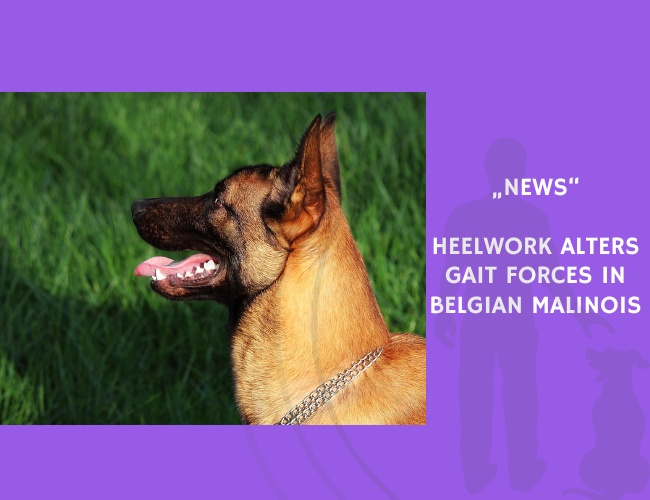
Heelwork walking is a specialized obedience movement in which dogs must walk closely aligned with their handler. While common in competitive obedience and working dog training, little research has examined its biomechanical effects on canine gait.
Charalambous and colleagues (2023) studied 10 healthy Belgian Malinois, analyzing gait both during normal walking and heelwork on a pressure platform. They measured vertical ground reaction forces, paw pressure distribution (PPD), and center of pressure (COP).
Results showed that during heelwork, dogs exhibited a decrease in vertical impulse and stance phase duration in the forelimbs, alongside an increase in COP speed. In contrast, the hindlimbs demonstrated an increase in vertical impulse and stance duration. Detailed analysis revealed reduced vertical impulse in specific forelimb quadrants, while most hindlimb quadrants showed increased loading.
These findings suggest that heelwork walking redistributes mechanical load from the forelimbs to the hindlimbs, potentially altering long-term musculoskeletal stress. The authors recommend further research using electromyography and kinematic analysis to understand the implications for performance, injury risk, and welfare in obedience and working dogs.
Source: Charalambous, D., Lutonsky, C., Keider, S., Tichy, A., & Bockstahler, B. (2023). Vertical ground reaction forces, paw pressure distribution, and center of pressure during heelwork in working dogs competing in obedience. Frontiers in Veterinary Science, 10. Published February 10, 2023.










