
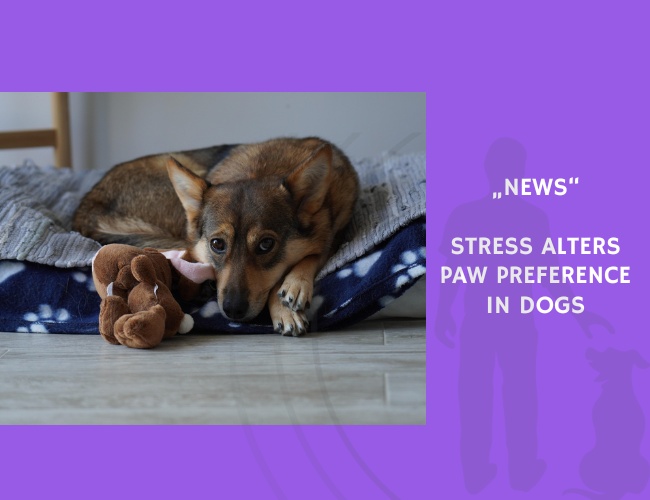
Behavioral laterality, such as a preference for using one paw over the other, reflects underlying cerebral asymmetries in animals. In humans, stress has been shown to influence brain lateralization, but this relationship had not been systematically studied in dogs. Demirbas and colleagues (2023) set out to examine how both acute and chronic stress affect motor laterality in domestic dogs.
The researchers tested 60 dogs—28 chronically stressed and 32 healthy—using two motor laterality assessments: the Kong™ Test and a Food-Reaching Test. Dogs were evaluated both in their familiar home environment and in a stressful open field test (OFT) environment. Physiological stress markers, including salivary cortisol, respiratory rate, and heart rate, confirmed successful stress induction during the OFT.
Results revealed a striking pattern: dogs under acute stress tended to shift toward ambilaterality (using both paws more equally rather than favoring one), while chronically stressed dogs showed a weaker overall lateralization. Importantly, the first paw used in the food-reaching task proved a reliable predictor of an individual’s general paw preference.
These findings highlight how stress—both short-term and long-term—can subtly reshape dogs’ motor behavior. The study provides new insights into how stress alters brain–behavior dynamics in dogs, offering a potential non-invasive marker for assessing canine well-being.
Source: Demirbas, Y. S., Isparta, S., Saral, B., Yılmaz, N. K., Adıay, D., Matsui, H., Töre-Yargın, G., Musa, S. A., Atilgan, D., Öztürk, H., Kul, B. C., Şafak, C., Ocklenburg, S., & Güntürkün, O. (2023). Acute and chronic stress alter behavioral laterality in dogs. Scientific Reports, 13. Published March 11, 2023.










