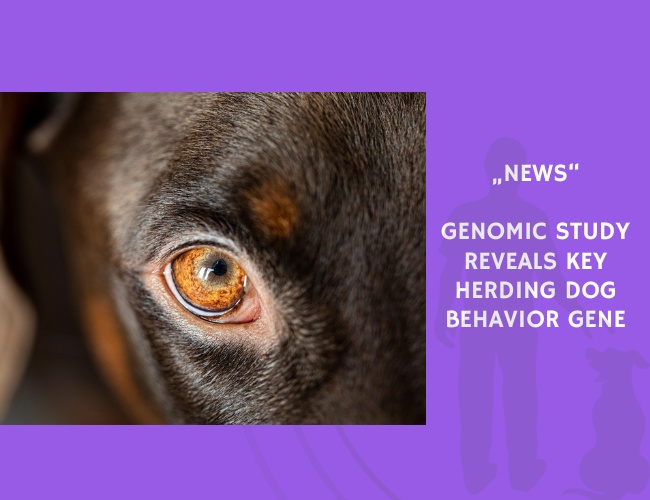
Herding dogs are renowned for their ability to guide and control livestock, a skill rooted in both instinct and learned commands. Until recently, the genetic underpinnings of these behaviors were poorly understood. Jeong, Ostrander, and Kim (2025) provide new genomic evidence that herding proficiency is strongly tied to selective sweeps in genes associated with cognition, social interaction, and motor control.
The researchers compared the whole-genome sequences of herding versus non-herding breeds. Among the strongest signals of positive selection, they identified haplotypes in the EPHB1 gene, previously linked to locomotor hyperactivity and spatial memory. Crucially, a working line–specific haplotype in border collies was found to correlate with elevated levels of chase-bite motor patterns, a behavior essential for directing livestock.
This haplotype was also observed to introgress with a genetically distant herding breed, the Entlebucher mountain dog, reinforcing its functional role across herding lineages. Behavioral surveys validated the association, showing that dogs carrying this variant expressed stronger herding-specific behaviors compared to conformation lines.
The study highlights how functional selection during breeding has not only shaped herding behavior but also refined the genetic architecture that enables these dogs to perform complex tasks. This genomic insight underscores the broader link between selective breeding, cognition, and working efficiency in dogs.
Source: Jeong, H., Ostrander, E., & Kim, J. (2025). Genomic evidence for behavioral adaptation of herding dogs. Science Advances, 11. Published April 30, 2025.