
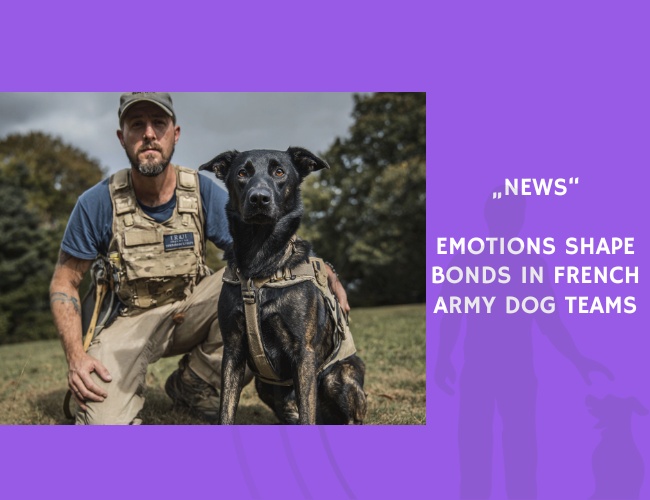
The role of dogs in military service goes beyond technical expertise such as explosive detection or search and neutralization tasks. Michenau, Bovet, Lamour, and Laguette (2024) conducted semi-structured interviews with 16 French Army handlers to explore the emotional and relational dynamics of canine teams through a qualitative, thematic analysis.
The study revealed that the human–dog relationship in military settings is multifaceted, extending far beyond functional duties. Handlers described bonds shaped by trust, affection, communication, and interdependence. Dogs’ individual personalities and emotional responses were central to the quality of these relationships, while handlers emphasized the importance of mutual support and cooperation both during training and in operational contexts.
One notable finding is the importance of moments of closeness outside of work. Valuing affectionate interactions outside missions strengthens the bond and enhances teamwork under pressure. The research also highlights the benefit of developing emotional skills in handlers, allowing them to better regulate their own emotions to avoid disrupting, and ideally to assist, their canine partners.
These results underscore that in military canine teams, emotions are not a weakness but a critical component of effective performance, resilience, and welfare for both handler and dog.
Source: Michenau, S., Bovet, D., Lamour, T., & Laguette, V. (2024). Emotions and Bonds Within Canine Teams Working in the French Army. Review of European Studies.










