
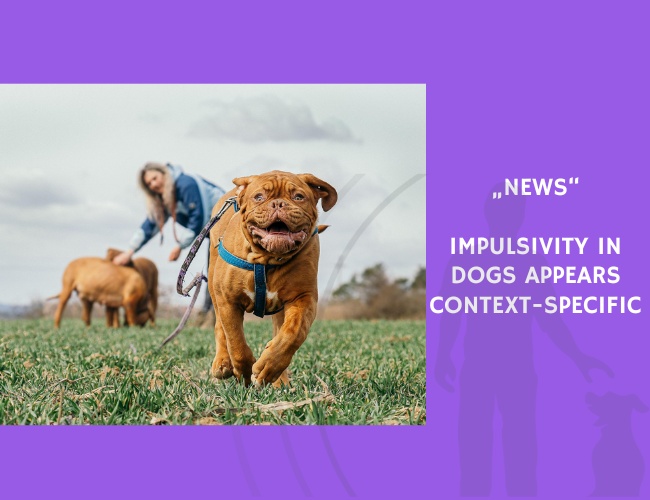
Impulsivity is often viewed as a key trait in dogs, influencing training outcomes and everyday interactions. Yet, whether it is a stable characteristic across contexts has been unclear. Barela et al. (2023) conducted a systematic review and meta-analysis of studies investigating dog impulsivity to address this question.
From over 10,000 bibliographic records, the authors identified 13 studies where the same dogs were tested across multiple impulsivity tasks. Across 31 task comparisons, 28 showed no correlation and only three revealed a connection. Similarly, when comparing task performance with owner perceptions of impulsivity, results were inconsistent, with the majority showing no significant relationship.
A formal meta-analysis of two widely used tests—the A-not-B task and the cylinder task—spanning seven studies, found no overall correlation. These findings suggest that impulsivity in dogs does not function as a consistent, cross-context trait but rather emerges in a context-dependent manner.
This conclusion challenges the assumption that impulsivity can be measured as a single personality dimension in dogs. Instead, the study highlights the importance of evaluating specific contexts—whether in training, home life, or work environments—when considering impulsivity-related behaviors.
Source: Barela, J. D., Worth, Y. A., & Stevens, J. (2023). Impulsivity as a trait in domestic dogs (Canis familiaris): A systematic review and meta-analysis. Journal of Comparative Psychology.










