
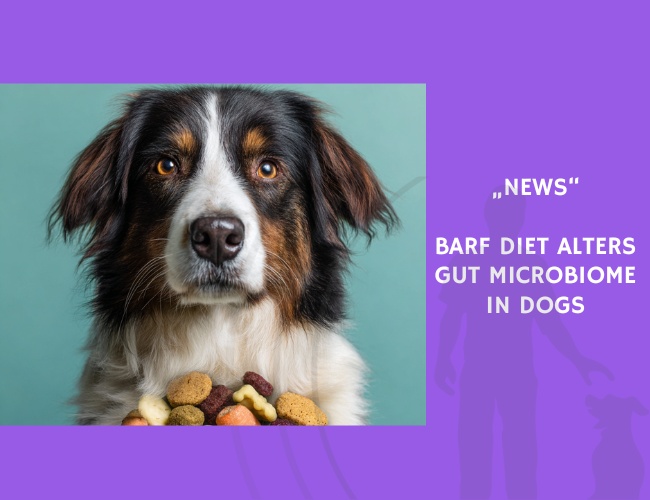
BARF diets—rich in raw meat, offal, and bones with minimal plant matter—are increasingly popular among dog owners. While they promise a more “natural” feeding approach, questions remain about their effects on health and digestion. To address this, Schmidt et al. (2018) compared the fecal microbiota and metabolome of 27 BARF-fed and 19 commercially fed dogs.
Results showed significant dietary differences: BARF-fed dogs consumed more protein and fat but less fiber and carbohydrates. These nutritional shifts corresponded with marked differences in gut microbial composition. BARF-fed dogs showed higher levels of Lactobacillales, Enterobacteriaceae, Fusobacterium, and Clostridium, while commercial-fed dogs had more Clostridiaceae, Ruminococcaceae, and Lachnospiraceae. Importantly, qPCR analysis revealed a higher abundance of E. coli and Clostridium perfringens in BARF-fed dogs, alongside an increased dysbiosis index.
Metabolomics analysis further supported these findings. BARF-fed dogs had elevated levels of compounds such as 4-hydroxybutyric acid and GABA, as well as higher fecal cholesterol compared to commercial-fed dogs. Although some metabolite differences lost statistical significance after correction, clear clustering of metabolite profiles by diet type was observed.
Overall, the study demonstrates that diet strongly shapes canine gut microbiota and metabolome. While BARF feeding induces distinct microbial and biochemical patterns, the implications for long-term health remain uncertain. The authors emphasize the need for further research to weigh potential benefits against risks, particularly regarding pathogen exposure and gut stability.
Source: Schmidt, M., Unterer, S., Suchodolski, J., Honneffer, J. B., Guard, B., Lidbury, J., Steiner, J., Fritz, J., & Kölle, P. (2018). The fecal microbiome and metabolome differs between dogs fed Bones and Raw Food (BARF) diets and dogs fed commercial diets. PLoS ONE, 13.










