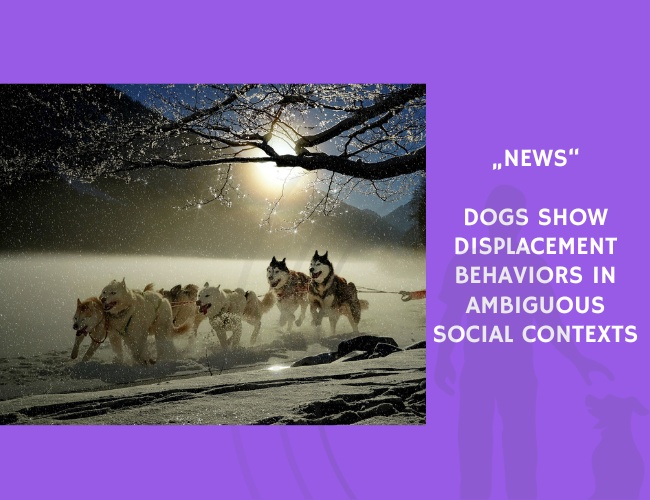
Displacement behaviors in dogs—such as yawning, sniffing, blinking, and lip-licking—have often been interpreted as appeasement signals intended to diffuse aggression. However, Pedretti and colleagues (2023) challenged this assumption by testing dogs with video stimuli of conspecifics in either threatening or neutral situations.
Fifty-six dogs were shown videos of female pet dogs displaying either threatening behavior (barking at a stranger dog) or neutral behavior (panting). These were paired with natural sounds or artificial pink noise. Dogs consistently looked longer at threatening videos, kept their ears forward in threatening conditions, and rotated their ears more in neutral ones.
Unexpectedly, displacement behaviors—including yawning, nose-licking, lip-wiping, and sniffing—were more common during the neutral condition. This suggests that such behaviors are not primarily used as appeasement during aggression but instead emerge in ambiguous contexts where predicting another dog’s behavior is difficult.
These findings refine our understanding of dog communication, highlighting that displacement behaviors may signal uncertainty rather than attempts to actively de-escalate conflict. The methodology also underscores the usefulness of ecologically valid video stimuli in studying intraspecific communication.
Source: Pedretti, G., Canori, C., Marshall-Pescini, S., Pavan, G., & Valsecchi, P. (2023). Behavioural Analysis of Dogs’ Response to Threatening and Neutral Conspecific Video Stimuli. Applied Sciences.