
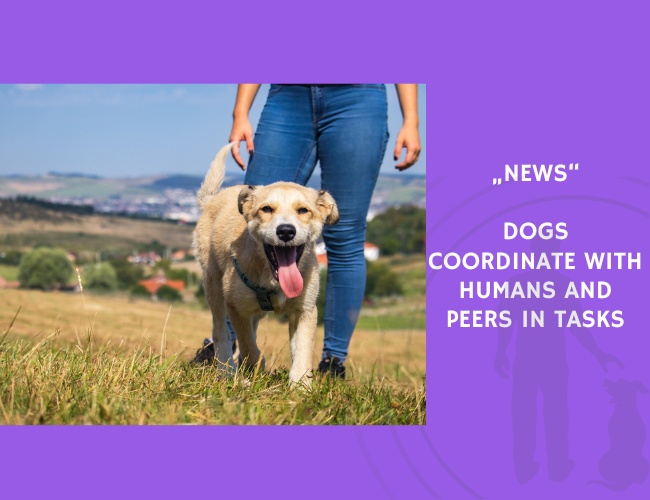
The process of domestication has been argued to enhance dogs’ socio-cognitive skills while reducing emotional reactivity, enabling them to thrive in close partnership with humans. Ostojić and Clayton (2013) investigated whether dogs could coordinate behaviorally in cooperative problem-solving tasks, working alongside either another dog or a human partner.
Using a well-established cooperative apparatus, researchers tested dogs’ ability to align their actions with their partner’s behavior. Success required dogs to wait for the right timing and attend to cues such as the partner’s movements and the incremental advancement of rewards. Although many dogs struggled with inhibiting premature actions, they succeeded in coordinating when they attended to these predictive cues.
Importantly, dogs displayed this behavioral coordination not only with conspecific partners but also with human partners. This finding underscores their remarkable socio-cognitive flexibility, which supports their role as cooperative companions in both human and dog social networks.
The results highlight that dogs’ cooperative capacities extend beyond simple task-solving. Instead, they involve cognitive processes of monitoring and adjusting actions to align with others, a skill that may have been reinforced through thousands of years of shared human–dog evolution.
Source: Ostojić, L., & Clayton, N. (2013). Behavioural coordination of dogs in a cooperative problem-solving task with a conspecific and a human partner. Animal Cognition, 17, 445–459. https://doi.org/10.1007/s10071-013-0676-1










