
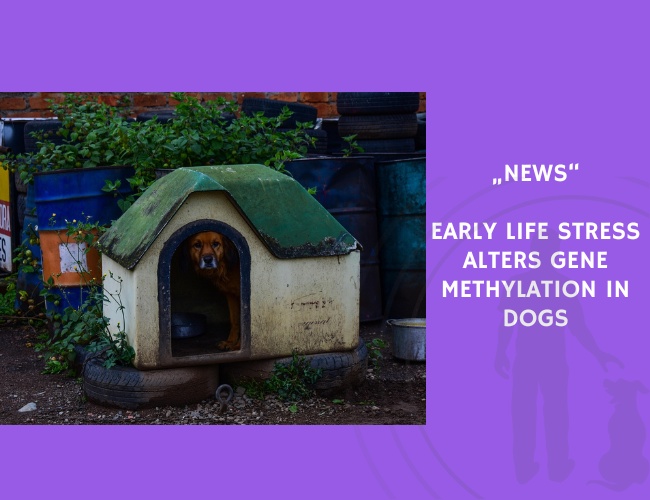
Early life deprivation and stress can cause life-long consequences across species, including epigenetic modifications that influence health and behavior. Domestic dogs, who share human environments and exhibit comparable social-cognitive traits, provide an important model for studying these effects.
Awalt and colleagues (2024) investigated 47 owner-dog dyads, comparing dogs rescued from abusive or neglectful conditions with well-matched control dogs. Researchers measured DNA methylation of the NR3C1 (glucocorticoid receptor) and OXTR (oxytocin receptor) genes, examined cortisol responses to separation stress, and assessed attachment styles.
Results revealed that dogs with adverse life histories had distinct NR3C1 methylation patterns influenced by age and showed lower OXTR methylation than control dogs. Although baseline-to-poststressor cortisol changes did not differ between groups, cortisol regulation was significantly associated with NR3C1 methylation levels. Importantly, dogs with adverse experiences displayed more insecure attachment styles, and higher OXTR methylation increased the likelihood of insecure bonding.
These findings highlight the powerful role of early experiences in shaping both physiology and social behavior in dogs. They also suggest that interventions aimed at improving welfare in neglected or abused dogs may need to account for epigenetic impacts on stress regulation and human-dog relationships.
Source: Awalt, S. L., Boghean, L., Klinkebiel, D., & Strasser, R. (2024). A dog’s life: Early life histories influence methylation of glucocorticoid (NR3C1) and oxytocin (OXTR) receptor genes, cortisol levels, and attachment styles. Developmental Psychobiology, 66(3), e22482. DOI: 10.1002/dev.22482










