
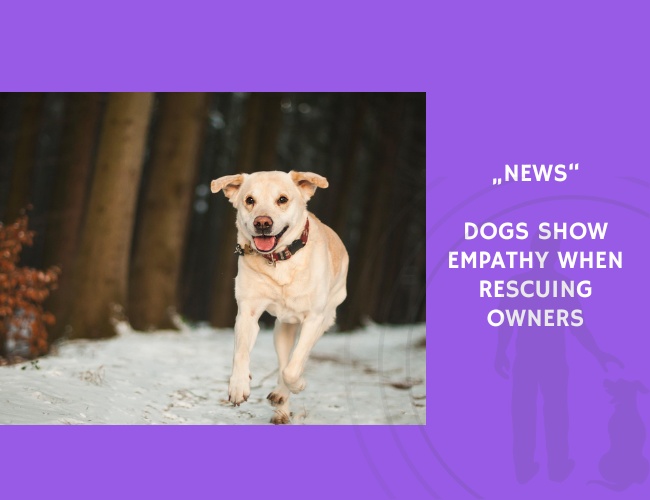
Joshua Van Bourg, James E. Patterson, and Clive Wynne (2020) tested whether 60 pet dogs would free their seemingly trapped owners. The study explored whether rescuing behavior was motivated by empathy or simply by other factors such as social facilitation or reward-seeking.
The experiment involved three conditions: (1) the distress test, in which owners called for help while trapped inside a large box; (2) the food test, in which high-value treats were placed inside the box; and (3) the reading test, in which owners sat inside calmly reading aloud. Dogs were as likely to release their distressed owners as they were to access food, showing that the act itself was highly rewarding.
Crucially, dogs released owners more often when they called for help compared to when they were reading calmly, suggesting a sensitivity to human emotional cues. Dogs also showed more stress behaviors during the distress test, reinforcing evidence of emotional contagion. Opening latencies decreased across trials in the distress test but not the reading test, indicating that rescuing behavior could not be explained solely by learning or social contact-seeking.
While success in the food task and prior experience with opening objects influenced performance, the findings support the interpretation that rescuing distressed owners can be an empathetically-motivated prosocial behavior in dogs.
Source: Bourg, J. V., Patterson, J. E., & Wynne, C. (2020). Pet dogs (Canis lupus familiaris) release their trapped and distressed owners: Individual variation and evidence of emotional contagion. PLoS ONE, 15. https://doi.org/10.1371/journal.pone.0231742










